those ao3 “kudos” emails where someone has gone through and read pretty much all of your stories, one after the other: blessings upon you and your household
don’t authors find that weird though? i don’t do that, just because i always figured it might seem stalkery, going story by story through people’s older work (which of course i do ~all the time~ because awesome fic is addictive)
if people are happy to have the kudos, i will totally start leaving them as i read
I mean, I can only speak for myself here, but no, I don’t find it creepy. Someone I’ve never met going through my old instagram selfies and systematically liking them – creepy. Someone I’ve never met obsessively reading my old fics and liking them – my favorite person of the day. Just MHO.
seeing the same person’s name on a string of kudos for your fics because they’ve obviously read through your back catalogue is one of life’s great joys
xcziel, there’s nothing I like more as a writer than someone who is obviously reading everything.
Well, maybe comments. Yes, on old fic too.
I once (back on lj) had someone comment on every single chapter of a fic I wrote in one evening. It was the most thrilling night of my fanfic career. I didn’t feel creepy in the least.
COMMENT. I don’t care how old it is or how many chapters a reader comments on.
The only thing that might possibly be more flattering is the “I stayed up all night because I couldn’t stop reading” comment.
Yes, please.
YES ALL OF THIS
all of this
Reblogging because readers somehow still have this idea that too many comments/kudos are seen as creepy or stalkery. IT’S NOT. Seriously. Every comment, all of the kudos, they’re greatly, GREATLY appreciated. And knowing that someone liked your work enough to click on your name and go through your other fics and liked those too, even the old stuff you’re kind of self-conscious about, is the greatest feeling a writer can have. So if you like a fic, say something/leave kudos, no matter if it’s the first or fifth fanfic you’ve read in one night from that author.
I LOVE when I get an email where it’s the same name, like a dozen or more times because they went through and read like, /everything I ever wrote/ apparently. It makes me so happy! 😀
Multiple kudos and/or lots of comments are the best thing ever
Not at all creepy. It’s like, they are reading, get to the end, said they liked it, and Prove they liked it because they read another and liked that…
And yes, it’s just as fun to see this with old stories. Maybe even more?
The other thing that is super nice? When someone comments and says, hey, I tried to kudos but I had already kudos’d so I’m commenting to kudos again because I do that ALL THE TIME. I either forgot I’d read this lovely thing and want to kudos again, or I’m doing a re-read of something and I *want* to kudos again. When it happens to me it’s seriously lovely – someone enjoying your stuff enough that they re-read.
I LOVE EVERY LAST PERSON WHO INTERACTS WITH MY FICS
With this post I listed 10 outline techniques to help writes move their story from a basic idea to a complete set of arcs, plots, sequences and/or scenes. Or to simply expand whatever you have in hands right now.
If you have a vague story idea or a detailed one, this post is for you to both discover and organize. A few technique will work perfectly. A few won’t. Your mission is to find the one that works best for you. That said, I advice you to try out as many techniques as possible.
So, are you ready? Open your notebook, or your digital document, and let’s start.
1. Snowflake method: Start with a one-sentence description of the novel. Then, develop this simple phrase into a paragraph. Your next step is to write a one-page summary based on the paragraph, you can write about characters, motivations, goals, plots, options, whatever you feel like. From this point on, you can either start your book or expand the one-page summary into four pages. And, at last, four pages into a brief description of known sequences of scenes. Your goal is to make the story more and more complex as you add information, much like a forming snowflake.
2. Chapter by chapter: List ten to twenty chapters, give each chapter a tittle and a brief description of what should happen. Then, break each chapter into three to five basic sequences of scenes. Give each sequence a title, a brief description and a short list of possibilities (possibilities of dialogues, scenarios, outcomes, moods, feelings… just play around with possibilities). From this point on, you can either create the scenes of sequences with a one-sentence description for each or jump straight to writing. Your goal is to shift from the big picture to a detail-oriented point of view.
3. Script: This might sound crazy, but, with this technique, you will write the screenplay of your story as if it’s a movie. No strings attached to creative writing, just plain actions and dialogues with basic information. Writing a script will take time, maybe months, but it will also enlighten your project like no other technique. Your goal is to create a cinematic view of your story. How to write a script here.
4. Free writing: No rules, no format, no step, just grab a pen or prepare your fingers to write down whatever idea that comes up. Think of possibilities, characters, places, quests, journeys, evolutions, symbolisms, fears, good moments, bad moments, clothing, appearances. Complete five to ten pages. Or even more. The more you write, the more you will unravel. You can even doodle, or paste images. Your mission is to explore freely.
5. Tag: This technique is ideal if you have just a vague idea of the story. Start by listing ten to fifteen tags related to the story. Under each tag, create possible plots. And, under each plot, create possible scenes. Grab a red felt pen and circle plots and scenes that sparkle your interest.
6. Eight-point arc: With this technique you will divide your story into eight stages. They are Stasis, Trigger, Quest, Surprise, Critical Choice, Climax, Reversal and Resolution. The Stasis is the every-day-life of your main character. Trigger is an event that will change the every-day-life of your character (for better or for worse). Quest is a period of your main characters trying to find a new balance, a new every-day-life (because we all love a good routine). Surprise will take your character away from their new found every-day-life. Critical Choice is a point of no return, a dilemma, your character will have to make the hardest decision out of two outcomes, both equally important. Climax is the critical choice put to practice. Reversal is the consequence of the climax, or how the characters evolved. Resolution is the return to a new (or old) every-day-life, a (maybe everlasting) balance.
7. Reverse: Write down a description of how your story ends, what happens to your characters and to those around them. Make it as detailed as possible. Then, move up to the climax, write a short scenario for the highest point of your story. From there, build all the way back to the beginning.
8. Zigzag: Draw a zigzag with as many up and downs as you want. Every up represents your main character moving closer to their goal. Every down represents your main character moving further from their goal. Fill in your zigzag with sequences that will take your character closer and farther from the goal.
9. Listing: The focus of this technique is exploring new ideas when your story feels empty, short or stagnated. You’ll, basically make lists. Make a long list of plot ideas. Make another list of places and settings. Make a list of elements. And a list of possible characters. Maybe a list of book titles. Or a list of interesting scenes. A list of bad things that could happen inside this universe. A list of good things. A list of symbolism. A list of visual inspiration. A list of absurd ideas you’ll probably never use. Then, gather all this material and circle the good items. Try to organize them into a timeline.
10. Character-driven: Create a character. Don’t worry about anything else. Just think of a character, their appearance and style. Give them a name. Give them a basic personality. Give them a backstory. Develop their personality based on the backstory. Now, give this character a story that mirrors their backstory (maybe a way to overcome the past, or to grow, or to revenge, or to restore). Based on your character’s personality, come up with a few scenes to drive their story from beginning to end. Now, do the same thing for the antagonist and secondary characters.
So, when is it time to stop outlining and start writing?
This is your call. Some writers need as many details as they can get, some need just an basic plot to use as a North. Just remember, an outline is not a strict format, you can and you will improvise along the way. The most important is being comfortable with your story, exploring new ideas, expanding old concepts and, maybe, changing your mind many times. There’s no right or wrong, just follow your intuition.
I’ve seen five different authors take down, or prepare to take down, their posted works on Ao3 this week. At the same time, I’ve seen several people wishing there was more new content to read. I’ve also seen countless posts by authors begging for people to leave comments and kudos.
People tell me I am a big name fan in my chosen fandom. I don’t quite get that but for the purposes of this post, let’s roll with it. On my latest one shot, less than 18% of the people who read it bothered to hit the kudos button. Sure, okay, maybe that one sort of sucked. Let’s look at the one shot posted before that – less than 16% left kudos. Before that – 10%, and then 16%. I’m not even going to get into the comments. Let’s just say the numbers drop a lot. I’m just looking at one shots here so we don’t have to worry about multiple hits from multiple chapters, people reading previous chapters over, etc. And if I am a BNF, that means other people are getting significantly less kudos and comments.
Fandom is withering away because it feels like people don’t care about the works that are posted. Why should I go to the trouble of posting my stories if no one reads them, and of the people who do read them, less than a fifth like them? Even if you are not a huge fan of the story, if it kept your attention long enough for you to get to the bottom, go ahead and mash that kudos button. It’s a drop of encouragement in a big desert.
TL;DR: Passively devouring content is killing fandom.
Reblogging again
So much this
You know, kudos and comments are much beloved by all esp. yrs truly, but I have to say: I’ve been posting fic for 20 years, and I have never in my entire life had a story stay above a 1:9 kudos to hits ratio (or comments to hits, back when kudo wasn’t an option). Usually they don’t stay above 1:10, once they’ve been around for a few weeks.
I also have a working background in online marketing. In social media 1:10 is what you would call a solid engagement score, when people actually care about your product (as opposed to “liking” your Facebook page so they could join a contest or whatever). If BNFs are getting 1:5 – and I do sometimes see it – that is sky-high engagement. Take any celebrity; take Harry Styles, who has just under 30M followers and doesn’t tweet all that often. He regularly gets 3-400K likes, 1-200K retweets. I’ve seen him get up to just under 1M likes on a tweet. That’s a 1:30 engagement ratio, for Harry Styles, and though some of you guys enjoy my fics and have said so, I don’t think you have as lasting a relationship with my stories as Harry Styles’s fans do with him. XD;
Again, this is not to say we, as readers, should all go home and not bother to kudo or comment or engage with fic writers. That definitely is a recipe for discouraging what you want to see in future. But this is not the first post I’ve seen that suggests a 20% kudo ratio is the equivalent of yelling into the void, and I’m worried that we as writers are discouraging ourselves because our expectations are out of whack.
I think about this a lot, because it’s important to know what a realistic goal to expect from an audience is, even though I admit it definitely is kind of depressing when you look at the numbers. I was doing reading on what sort of money you can expect to make from a successful webcomic, and the general rule of thumb seems to be that if your merchandising is meshing well with your audience, about 1% will give you merch. I imagine ‘subscribe to patreon’ also falls in this general range.
Stuff that is ONLY available for dollars are obviously going to have a different way of measuring this, but when it comes to ‘If people can consume something without engaging back in any fashion (hitting a like button, buying something, leaving a comment)’ the vast majority will.
And as a creator that is frustrating but as a consumer it’s pretty easy to see how it happens. I have gotten steadily worse at even liking posts, much less leaving comments on ones I enjoy, since I started using tumblr. It’s very difficult to engage consistently. I always kudo on any fanfic I read and comment on the vast majority, but then again I don’t read a lot of fanfic, if you are someone who browses AO3 constantly/regularly for months or years, I could see how it’s easy to stop engaging. I don’t remember to like every YT video or tumblr fanart I see, much less comment on them.
When we are constantly consuming free content it’s hard to remember to engage with it or what that engagement means to the creators. And lol, honestly that sucks. Certainly as consumers we should be better about it. But also like, as a creator be kinder to yourself by setting a realistic bar of what you can achieve.
And IMO, if numbers matter to you (kudos, comments, etc) be honest about the fact that you CAN improve those things by marketing yourself better. The ‘I just produced my art and put it out there and got insanely popular because it was just so brilliant’ is less than a one a million chance. Lots of amazing content is overlooked every day because there is a lot of good content and a metric fuckton of mediocre to bad content. You can only SORT of judge the quality of your work based on the audience it generates, but if what you WANT is an audience there is way, way, WAY more you can be doing than simply producing whatever you immediately feel like. Marketing yourself is a skill and if you want the benefits of it you have to practice it.
I have a professional background in internet marketing as my day job and a moderate hobby business. My definition for “moderate” is “it pays for itself, keeps me in product, and occasionally buys groceries.”
In the day job, which is for an extremely large global company, there are entire teams of people whose entire purpose of employment is to ensure a 3% conversion rate. That’s it. That is for a Fortune 100 company: the success metric is for 3% of all visitors to a marketing web site to click the “send me more info” link.
My moderate business that pays for itself has a 0.94% conversion rate of views to orders. Less than 1%, and it’s still worth its time – and this is without me bothering to do any marketing beyond instagram and tumblr posts with new product.
I know it feels like no one is paying attention to you and you’re wasting your time if you don’t get everyone clicking kudos or commenting but I promise, I PROMISE, you are doing fantastically, amazingly well with your 10% rate. You probably aren’t going to go viral AND THAT’S FINE. You’re only hurting yourself if you’re expecting a greater return – don’t call yourself a failure, because you’re NOT. You’re just looking at it the wrong way. I promise, you’re lovely just the way you are.
This entire thing is fascinating to me. Truth is, I don’t even look at the ratio of hits to kudos on my fics. That number’s kinda meaningless to me, because as a reader, I’ve probably been responsible for AT LEAST dozens of hits on each of my favorite fics – for which AO3 only allowed me to leave a single kudos.
I also open fics on multiple devices to read/reread them. I open tabs for fics I intend to look at later and then revisit them (often multiple times) before I get a chance to actually sit down and read them. These things add up.
Hits without equivalent kudos don’t mean people aren’t enjoying a fic. It might be the exact opposite. It might mean you have people who love your fic so much they’ve read it ten times this month – on their laptops, phones, tablets, etc…and ten times the month before.
Kudos and comments mean A LOT. I know this as a writer who gets overwhelmed and excited by every single new comment, bookmark with notes, tumblr tag, and kudos email. But fixating too much on the numbers is a frustrating and futile process. I know it’s hard to not get caught up in that, but it really shouldn’t be something that you let discourage you from continuing to share your work.
The math behind this is really interesting and encouraging. That having been said…
Click the kudos button. Leave comments.
Engage, please. Just because some of us authors/artists will never take our work down, no matter what, doesn’t mean others won’t get discouraged and peace out of fandom if they feel like no one likes their work. When I first joined fandom, like, 15 years ago, pretty much everyone left comments.There was no “kudos” system (though at least one archive I used had a 5-star rating system) so you got way more comments because it was the only feedback option, really. But also, because fandom tended to be more engaged as a whole with its content creators.
Let me put it to you this way: if you can take the time to bitch about how the content you want to see is rare/scarce/you’ve read everything…you can take the time to thank the content creators whose work you’ve consumed. Side benefit? You’re likely to get more content because the creator will be happy and motivated. Think about how much time/effort the creators put into the fics you read and the fanart/comics you view. Then tell me again why you can’t spare a few moments to leave kudos/a comment.
Also…you reread and can’t leave a second kudos? Leave a comment saying “more kudos”. I legit just got one saying – “You have already left kudos here.” I know, AO3! – and I was thrilled. Because this person reread and wanted to leave me more kudos. And it was literally a super-short comment that just…gave me an extra kudos. It’s not that hard to engage with the content creators in your fandom.
So please, just…do the thing.
It is a truth universally acknowledged, that a single man in possession of a good fortune, must be in want of a wife. And then the murders began.
Mrs. Dalloway said she would buy the flowers herself. And then the murders began.
In the beginning God created the heaven and the earth. And then the murders began.
The phantom of the opera did exist. And then the murders begun.
Maman died today. And then the murders began.
It was a bright cold day in April, and the clocks were striking thirteen. And then the murders began.
In 1815 Monsieur Charles-Francois-Bienvenu Myriel was Bishop of Digne. And then the murders began.
Arma virumque cano, Troiae qui primus ab oris Italiam, fato profugus, Laviniaque venit litora, multum ille et terris iactatus et alto vi superum saevae memorem Iunonis ob iram; multa quoque et bello passus, dum conderet urbem, inferretque deos Latio, genus unde Latinum, Albanique patres, atque altae moenia Romae. Deinde homicidia coeperunt.
When Mr. Bilbo Baggins of Bag End announced that he would shortly be celebrating his eleventy-first birthday with a party of special magnificence, there was much talk and excitement in Hobbiton. And then the murders began.
In my younger and more vulnerable years my father gave me some advice I’ve been turning over in my mind ever since. And then the murders began.
Listeth lordes, in goode intent
And I wolle tell verrayment
Of truth and of solas:
And thenne the murdyres began.
Mr. and Mrs. Dursley of number four, Privet Drive, were proud to say that they were perfectly normal, thank you very much. And then the murders began.
The man in black fled across the desert and the gunslinger followed. And then the murders began.
It was the best of times, it was the worst of times, it was the age of wisdom, it was the age of foolishness, it was the epoch of belief, it was the epoch of incredulity, it was the season of Light, it was the season of Darkness, it was the spring of hope, it was the winter of despair, we had everything before us, we had nothing before us, we were all going direct to Heaven, we were all going direct the other way – in short, the period was so far like the present period, that some of its noisiest authorities insisted on its being received, for good or for evil, in the superlative degree of comparison only. And then the murders began.
A young man stands in his bedroom. And then the murders began.
What does the Persian poet say about the first man to seek the crown of world sovereignty? And then the murders began.
Snow was falling on Riverside, great white feather-puffs that veiled the
cracks in the facades of its ruined houses; slowly softening the harsh
contours of jagged roof and fallen beam.
And then the murders began.
I just wanted a plate of waffles. And then the murders began.
The late twentieth century has witnessed a scientific gold rush of astonishing proportions: the
headlong and furious haste to commercialize genetic engineering. And then the murders began.
(image is a tweet by Marc Laidlaw saying that any story can be improved by making sure the second sentence is, “And then the murders began.”)
It just kills me when writers create franchises where like 95% of the speaking roles are male, then get morally offended that all of the popular ships are gay. It’s like, what did they expect?
I feel this is something that does often get overlooked in slash shipping, especially in articles that try to ‘explain’ the phenomena. No matter the show, movie or book, people are going to ship. When everyone is a dude and the well written relationships are all dudes, of course we’re gonna go for romance among the dudes because we have no other options.
Totally.
A lot of analyses propose that the overwhelming predominance of male/male ships over female/female and female/male ships in fandom reflects an unhealthy fetishisation of male homosexuality and a deep-seated self-hatred on the part of women in fandom. While it’s true that many fandoms certainly have issues gender-wise, that sort of analysis willfully overlooks a rather more obvious culprit.
Suppose, for the sake of argument, that we have a hypothetical media franchise with twelve recurring speaking roles, nine of which are male and three of which are female.
(Note that this is actually a bit better than average representaton-wise – female representation in popular media franchises is typicaly well below the 25% contemplated here.)
Assuming that any character can be shipped with any other without regard for age, gender, social position or prior relationship – and for simplicity excluding cloning, time travel and other “selfcest”-enabling scenarios – this yields the following (non-polyamorous) possibilities:
Possible F/F ships: 3 Possible F/M ships: 27 Possible M/M ships: 36
TOTAL POSSIBLE SHIPS: 66
Thus, assuming – again, for the sake of simplicity – that every possible ship is about equally likely to appeal to any given fan, we’d reasonably expect about (36/66) = 55% of all shipping-related media to feature M/M pairings. No particular prejudice in favour of male characters and/or against female characters is necessary for us to get there.
The point is this: before we can conclude that representation in shipping is being skewed by fan prejudice, we have to ask how skewed it would be even in the absence of any particular prejudice on the part of the fans. Or, to put it another way, we have to ask ourselves: are we criticising women in fandom – and let’s be honest here, this type of criticism is almost exclusively directed at women – for creating a representation problem, or are we merely criticising them for failing to correct an existing one?
YES YES YES HOLY SHIT YES FUCKING THANK YOU!
Also food for thought: the obvious correction to a lack of non-male representation in a story is to add more non-males. Female Original Characters are often decried as self-insertion or Mary Sues, particular if romance or sex is a primary focus.
I really appreciate when tumblr commentary is of the quality I might see at an academic conference. No joke.
This doesn’t even account for the disparity in the amount of screen time/dialogue male characters to get in comparison to female characters, and how much time other characters spend talking about male characters even when they aren’t onscreen. This all leads to male characters ending up more fully developed, and more nuanced than female characters. The more an audience feels like they know a character, the more likely an audience is to care about a character. More network television writers are men. Male writers tend to understand men better than women, statistically speaking. Female characters are more likely to be written by men who don’t understand women vary well.
But it’s easier to blame the collateral damage than solve the root problem.
Yay, mathy arguments. 🙂
This is certainly one large factor in the amount of M/M slash out there, and the first reason that occurred to me when I first got into fandom (I don’t think it’s the sole reason, but I think it’s a bigger one than some people in the Why So Much Slash debate give our credit for). And nice point about adding female OCs.
In some of my shipping-related stats, I found that shows with more major female characters lead to more femslash (also more het). (e.g. femslash in female-heavy media; femslash deep dive) I’ve never actually tried to do an analysis to pin down how much of fandom’s M/M preference is explained by the predominance of male characters in the source media, but I’m periodically tempted to try to do so.
All great points. Another thing I notice is that many shows are built around the idea that the team or the partner is the most important thing in the universe. Watch any buddy cop show, and half of the episodes have a character on a date that is inevitably interrupted because The Job comes first… except “The Job” actually means “My Partner”.
When it’s a male-female buddy show, all of the failed relationships are usually, canonically, because the leads belong together. (Look at early Bones: she dates that guy who is his old friend and clearly a stand-in for him. They break up because *coughcoughhandwave*. That stuff happens constantly.) Male-male buddy shows write the central relationship the exact same way except that they expect us to read it as platonic.
Long before it becomes canon, the potential ship of Mulder/Scully or Booth/Bones or whatever lead male/female couple consumes the fandom. It’s not about the genders involved. Rizzoli/Isles was like this too.
If canon tells us that no other relationship has ever measured up to this one, why should we keep them apart? Don’t like slash of your shows, prissy writers? Then stop writing all of your leads locked in epic One True Love romance novel relationships with their same-sex coworkers. Give them warm, funny, interesting love interests, not cardboard cutouts…
If the media is about a man, then the most important relationship(s) the protagonist has will be with a man.
If the media is about a women, then the most important relationship the protagonist will have will also be with a man.
That’s why the only time you get very well developed romance tends to be in media with female protagonists. Otherwise, the most developed relationship will be the bond between the male hero and his male best friend (or friends), with a woman there for the hero to kiss (even if his relationship with this woman as little or no development or isn’t even romantic) just to reassure the audience that our male hero isn’t gay and still ‘gets the girl’, as if kissing a girl is some sort of check mark.
With so few works even passing the Bechdel Test (i.e. is there more than one woman and do they talk to each other about something other than a man), it’s no wonder that F/F pairings are rare. There’s hardly any female characters who speak to each other around too ship and often shipping is inspired by canon character interaction of development.
When you lose interest in a story that you’re writing but YOU HAVEN’T LOST INTEREST IN THE STORY, YOU’VE JUST LOST INTEREST IN THAT PARTICULAR PART THAT YOU’RE WRITING AND YOU WANT TO GET TO THE GOOD STUFF THAT YOU’RE ACTUALLY INTERESTED IN BUT YOU CAN’T DO THAT WITHOUT FINISHING THE BORING PARTS
Tip: Skip it.
Literally put [stuff] then write what you want and go back and fill in the other stuff later. It’ll help. Trust me.
It disturbs me that men think any kind of image that plays to sexuality is default objectifying. Like, I’ve seen men, feminists, laugh off the appearance of Chris Hemsworth in the Ghostbusters trailer as objectifying – even as something that would be positive if it wasn’t actually in the movie. Something the makers put in just to make meninists mad.
I’ve been thinking about that and trying to put into words exactly how many levels of fucked up are going on in that sentiment. And it’s hard because these are men who mean well and are trying to understand about objectification, but…
Liiiiiiiike, yes, it’s eye-candy. It’s honest-to-god eye-candy that plays to the (heterosexual/boy-liking) female gaze, and we are starved of that, but let’s be real: that is a fully clothed man shot from the waist-up engaged in agentful action, dressed and behaving in a way that reflects character and characteristics that do not revolve around women or attraction. THAT IS NOT OBJECTIFICATION.
It’s like a strawman understanding of feminist analysis of the objectification of women in film. Objecting to sexual objectification is not about saying you can have nothing sexy in your film. Suggesting otherwise plays into the myth that women’s sexual drives are less than mens, and that men want theirs to be pandered to more because it is more demanding upon them and they can’t ‘help’ themselves.
I mean, are you kidding me? Are men so used to the objectification of women that the above seems objectifying in comparison to, say, even one of the least objectified female action heroes of our time, Black Widow?
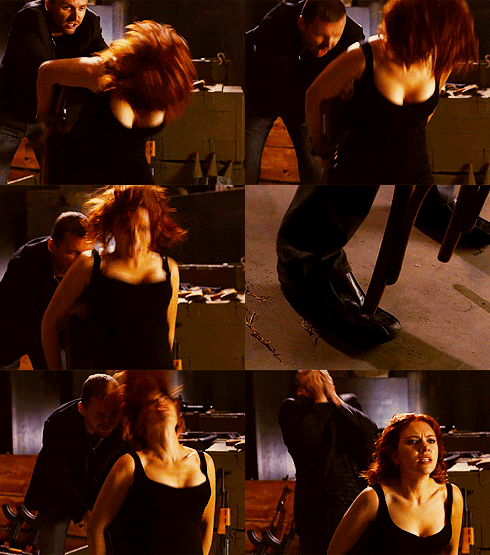
Objectification is when your introductory scene in the film is ostensibly about your skill as an interogator, but you’re scantilly clad and shots that are supposed to demonstrate your intelligence are actually framed to focus on your breasts:
And even your fight moves are filmed to focus on your breasts:
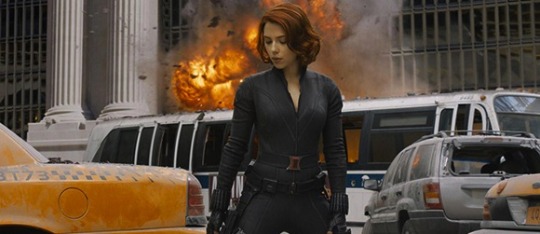
And even when you get to be the cool person who doesn’t look back at explosions, you have to stand in a sexual, rather than action pose, and your face remains serenly calm, because women aren’t allowed to express anything that might prevent them looking pretty even in the middle of a fight (and this is something your supposedly feminist director has actually said to you):
And you’re the only one in a team of heroes whose costume is actually skin-tight and unzipped to show your cleavage.
And this is a character widely praised as being much less objectified than women usually are in action films.
Don’t tell me Chris Hemsworth is being objectified in Ghostbusters – HE IS NOT. He’s a good looking man, for whom part of his role in this film is eye-candy. The only thing that’s new is that he’s not in a dominance role – he’s not the leading man, he doesn’t lead the team, he supports them. Do men seriously think that just not being in charge means they’re being objectified?
Don’t tell me this is objectification. And seriously don’t tell me you think it would be a laugh if these shots weren’t even in the film because, lol, it’s just some kind of joke to get misogynists riled up. Fuck you. That’s my ever-so-rare eye-candy. Hands off. I don’t get to see this very often.
Do men seriously think that just not being in charge means they’re being objectified?





 blackash26