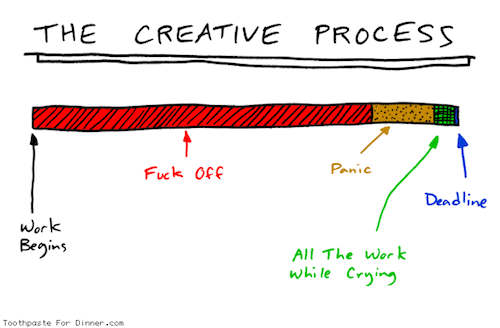
It’s been actual years since I’ve had the energy or inspiration for writing. Grad school is kind of all consuming in terms of creative juices.

But, uh, as tumblr is burning down around us, She-Ra and the Princesses of Power is the best thing I’ve seen in ages. So, yeah. Stay tuned, friends. I’m going to ride this wave as long as it lasts.

P.S. My writing will always and forever be on ao3 under blackash26

amarielah:

anduniela:

inkandcayenne:

As a professor, may I ask you what you think about fanfiction?

I think fanfiction is literature and literature, for the most part, is fanfiction, and that anyone that dismisses it simply on the grounds that it’s derivative knows fuck-all about literature and needs to get the hell off my lawn.

Most of the history of Western literature (and probably much of non-Western literature, but I can’t speak to that) is adapted or appropriated from something else.  Homer wrote historyfic and Virgil wrote Homerfic and Dante wrote Virgilfic (where he makes himself a character and writes himself hanging out with Homer and Virgil and they’re like “OMG Dante you’re so cool.“  He was the original Gary Stu).  Milton wrote Bible fanfic, and everyone and their mom spent the Middle Ages writing King Arthur fanfic.  In the sixteenth century you and another dude could translate the same Petrarchan sonnet and somehow have it count as two separate poems, and no one gave a fuck.  Shakespeare doesn’t have a single original plot–although much of it would be more rightly termed RPF–and then John Fletcher and Mary Cowden Clarke and Gloria Naylor and Jane Smiley and Stephen Sondheim wrote Shakespeare fanfic.  Guys like Pope and Dryden took old narratives and rewrote them to make fun of people they didn’t like, because the eighteenth century was basically high school.  And Spenser!  Don’t even get me started on Spenser.

Here’s what fanfic authors/fans need to remember when anyone gives them shit: the idea that originality is somehow a good thing, an innately preferable thing, is a completely modern notion.  Until about three hundred years ago, a good writer, by and large, was someone who could take a tried-and-true story and make it even more awesome.  (If you want to sound fancy, the technical term is imitatio.)  People were like, why would I wanna read something about some dude I’ve never heard of?  There’s a new Sir Gawain story out, man!  (As to when and how that changed, I tend to blame Daniel Defoe, or the Modernists, or reality television, depending on my mood.)

I also find fanfic fascinating because it takes all the barriers that keep people from professional authorship–barriers that have weakened over the centuries but are nevertheless still very real–and blows right past them. Producing literature, much less circulating it, was something that was well nigh impossible for the vast majority of people for most of human history.  First you had to live in a culture where people thought it was acceptable for you to even want to be literate in the first place.  And then you had to find someone who could teach you how to read and write (the two didn’t necessarily go together).  And you needed sufficient leisure time to learn.  And be able to afford books, or at least be friends with someone rich enough to own books who would lend them to you.  Good writers are usually well-read and professional writing is a full-time job, so you needed a lot of books, and a lot of leisure time both for reading and writing.  And then you had to be in a high enough social position that someone would take you seriously and want to read your work–to have access to circulation/publication in addition to education and leisure time.  A very tiny percentage of the population fit those parameters (in England, which is the only place I can speak of with some authority, that meant from 500-1000 A.D.: monks; 1000-1500: aristocratic men and the very occasional aristocratic woman; 1500-1800: aristocratic men, some middle-class men, a few aristocratic women; 1800-on, some middle-class women as well). 

What’s amazing is how many people who didn’t fit those parameters kept writing in spite of the constant message they got from society that no one cared about what they had to say, writing letters and diaries and stories and poems that often weren’t discovered until hundreds of years later.  Humans have an urge to express themselves, to tell stories, and fanfic lets them.  If you’ve got access to a computer and an hour or two to while away of an evening, you can create something that people will see and respond to instantly, with a built-in community of people who care about what you have to say.

I do write the occasional fic; I wish I had the time and mental energy to write more.  I’ll admit I don’t read a lot of fic these days because most of it is not–and I know how snobbish this sounds–particularly well-written.  That doesn’t mean it’s “not good”–there are a lot of reasons people read fic and not all of them have to do with wanting to read finely crafted prose.  That’s why fic is awesome–it creates a place for all kinds of storytelling.  But for me personally, now that my job entails reading about 1500 pages of undergraduate writing per year, when I have time to read for enjoyment I want it to be by someone who really knows what they’re doing.  There’s tons of high-quality fic, of course, but I no longer have the time and patience to go searching for it that I had ten years ago. 

But whether I’m reading it or not, I love that fanfiction exists.  Because without people doing what fanfiction writers do, literature wouldn’t exist.  (And then I’d be out of a job and, frankly, I don’t know how to do anything else.)

That’s perfect ❤

To critique or not to critique (of the unsolicited kind)

tarysande:

withsugarandlime:

tarysande:

Spoiler alert: I firmly belong to the not camp.

A post just crossed my dash that put the worst taste in my mouth. I don’t want to reblog it, but I do want to address the contents because I think the subject is super important.

The post basically boiled down to: fanfic writers are thin-skinned babies “these days” because no one can take constructive criticism. In “my day” we all sent page-long critiques like the dedicated heroes we were! It made us better writers! Moreover, if I didn’t like something, I told the writer all about it! It was my job!

Hold up, what?

I’ve been posting fanfic online since 1998. Twenty years. Pre-archives. And “in my day” we had betas if we wanted/needed/asked for them (whose critiques didn’t have an audience). We said “concrit welcome” if we actually wanted constructive criticism. We did not show up unannounced to point out a work’s flaws because that is rude. Look, I am an editor. People pay me real money to edit things for them. I would rather cut off my own fingers than burst into someone’s comments and start “critiquing” their work without being asked first.

Here’s something that needs to be addressed: fanfiction is real writing, yes, but it is, by its nature as something that isn’t monetized, a hobby. As in, a thing people do for fun. A thing that hopefully brings both authors and readers joy! The story an author posts is a gift; how dare anyone rip a gift apart in front of the gift-giver and all the other party attendees? How entitled and ungrateful can you be? Fandom is not a frigging battleground where authors learn to harden themselves for war. It’s a hobby. Done out of love and enthusiasm. 

Yes, some fanfiction writers (certainly not all!!) aspire to be original fiction writers. They may use fanfiction as a training ground. They may want or benefit from constructive criticism. Still, they have to ask. They have to start the conversation. I know (think?) it’s harder to find betas these days, but it’s always worth asking around if real critique is what you want. Put “concrit welcome and even begged for” in the author’s notes and hope someone takes you up on it. 

Some fanfiction writers with original fiction aspirations still don’t want criticism about their fic. Fic may be their fun-writing outlet. It may be about instant gratification (and there’s nothing wrong with that; we’re not in the business of denying ourselves pleasure out of some moral superiority here. It’s fandom). It may be the place where they post to get around their fears of showing things to others. It may be the place they take risks they wouldn’t in their original work because the stakes are lower. When you work on your original writing all day, every day—often putting that work through far more vigorous and exhausting paces than fanfic sees—the last thing you want is someone showing up during your time off to point out a frigging comma splice or shift in POV.

The point is unless someone asks for critique, you don’t know what’s going on with them. Maybe fic is the only fun thing they have in their lives. Maybe they’re writing in a different language. Maybe they are 14. Or 82. Maybe they’ve never written fiction of any kind before and this is their baby step forward. Maybe fic is just escapism. Maybe they are depressed or anxious as hell and criticism is going to push them over an edge. Fandom belongs to everyone. Not just people deemed “good” or “perfect” or “permitted” or “thick-skinned.” People don’t need to be saved from grammar mistakes or poor turns of phrase or even plotholes so wide a semi could drive through them. Authors sure as hell don’t need to be told when a reader just doesn’t like something. There is no fandom police force in charge of perfection. If critique is so important to you, advertise your willingness to beta. If you do not like a story or think it’s “bad” hit the freaking back button. 

Unsolicited criticism is not helpful. Maybe you just catch someone off-guard and startle them. At worst, you may totally shatter someone’s self-esteem while they are partaking in a hobby they 100% do for fun—and not in pursuit of some unattainable perfection.

Don’t ruin a stranger’s day or week or hobby because you “know better” and somehow think you need to prove it. You don’t.

A friend and I were scowling over that same post last night, and this is a much kinder response than the one that I started writing. I love and agree with 100% of what you’ve said here, but I’d like to go a step farther, because I think that fandom’s general evolution away from negative feedback is about more than just our amateur status. I always see the assumption in the pro-unsolicited-criticism camp that negative criticism is somehow the only thing that can ever help a writer improve, and I’ve always found that idea to be absolute horseshit. Hearing things that people liked about my work isn’t some kind of newfangled emotional safety feature that’s keeping my fandom babyhood intact, it’s genuinely helpful to me as a writer. Not only in the sense that it feels nice and makes me motivated to write more, but in the sense that it gives me specific information about how a reader responded to my work which I can then use to do an even more enjoyable job of engaging my fellow fans for fun the next time I write something. Friendly positive comments ARE constructive criticism!! 

Also (and I’d love to get your perspective on this as an editor?) I’ve found that negative criticism tends to be very work-specific. It’s stuff like “don’t do this particular thing at this particular time,” or “I didn’t like that this specific character said this specific thing,” etc. That can be incredibly useful during the editing phase because it helps me polish a specific piece of writing. I can’t say enough good stuff about literally every editor and beta reader I’ve ever worked with, because each one of them made the stories they worked on stronger and more enjoyable, and they certainly didn’t limit themselves to unquestioning praise in their feedback.

Once I’ve posted (or published) a story, though, I am done editing it. I’m done fixing it, I’m done adjusting it, I’m probably done even thinking about it for at least a week. I mean, sure, if you spot a giant typo, fine, let me know, but someone telling me they didn’t like the pacing or that the characterization was all wrong or that my sentence structure didn’t fit the genre or whatever is absolutely useless, both to that particular work and to my writing as a whole. The thing is done. It’s built. Unless I have unwittingly perpetuated some kind of miserable bigotry or whatever, I am moving on to the next thing, which is very likely to be an entirely different thing. I’m genuinely sorry if a reader didn’t enjoy it, but for the love of the little baby jesus in the hay, why are they still wasting time on something they didn’t like when there’s an entire internet of other things out there for them to discover???

For whatever reason, positive notes about things I did right in a story are much easier for me to carry forward and apply to whatever I might work on next. Knowing that someone liked a scene or an idea or even a particular line tells me that all the various technical things I did to make that part of the story happen were successfully deployed. Knowing what I did right for readers lets me do it again, lets me build on it, lets me ponder new directions that I might go with whatever the thing was, even if I’m doing that in a completely different story or piece of writing.

So yeah, negative feedback on completed fic or published work that’s disguised as “constructive criticism” isn’t just kind of asshole-ish and antithetical to everything that fandom means to most of us, it also tends to be genuinely unhelpful in … basically every way.  Especially when you compare it to how helpful a positive comment of the same duration and detail would have been, both to the writer’s relationship with their hobby and to their growth as an artist.

THIS IS SUCH A GREAT ADDITION TO MY POST! MAX KUDOS. I agree with (and love) everything you’ve said 100%.

I think something most people don’t realize is that an editor’s (and beta’s) job isn’t to tear a work to shreds; it shouldn’t revolve around negativity at all. Ideally, an editor works with an author to yes, fix errors, but mostly to read, observe, analyze, and ask questions the author (who is so close to the work) might not have thought about. The editor is trying to preemptively ask the questions a confused reader might ask, so the reader never has to ask them. Those answers then help the author clarify, polish, and further build their work into something even better. Absolutely work-specific.

madgastronomer:

kingarthurscat:

quousque:

kingarthurscat:

bookcaseninja:

Does anybody have any writing tips for adhd writers?

@quousque Do you have any helpful tips or resources?

@bookcaseninja  @kingarthurscat hmmmm depends on what I’m writing, but I do have a bunch of methods that I’ve worked out that really help. Since most of what I write is academic papers (thanks, college), that’s what I have the most developed method for, but I do have strategies for fiction writing, too.

General tips: 

#1 tip is meds. It’s nigh impossible to write anything when you can’t focus for longer than like 8 seconds. Me without meds = 2 sentences per hour. Me with meds = four hours writing continuously, end result is 20 pages of Iliad Sci-Fi AU.

#2 is, if you happen to hit that Hyperfocus Highway, and you’re writing something that’s vaguely close to what you’re supposed to be writing, ride that train until it fucking dies. A 25-page data-driven research paper isn’t quite the 7-10 page research-based persuasion essay I was assigned, but hey, it’s a complete assignment, and turning something in is better than turning nothing in.

#3, kill the perfectionist, or at least dodge them. Don’t have the perfect way to phrase something? Use parenthesis, or a different font color, and paraphrase what you want to say. My rough drafts are full of things like “hurrr something about how the prospective aspect /= imminent future” and “character x says something heartfelt here that makes character y mad”.

#4. Environment. Pay attention to what distracts you when you write, and design an environment where those things aren’t present. I have a really hard time writing anything in my own home or on my own computer, so I use google docs and the library for everything. This works really well, especially since I can’t remember by tumblr password so I can’t log on on the library computers, lol. There are internet blocking apps that block certain webpages or the entire internet for a set period of time. I once found a program that, once opened, won’t close or minimize until you’ve written a set number of words.

Random environmental tips that work for me: 

-standing desk, or sitting on an exercise ball.

-white noise. There’s tons of white noise generators online.

-egg timer. If I’m having trouble with distractions or spending too long on one thing, having the constant soft ticking of the egg timer really helps, since the sound isn’t too distracting, but is just distracting enough to remind me that time is a thing that is actively passing.

#5. Don’t know what words to write next? Talk out loud. Or whisper, if you’re in the library. Seriously, read aloud what you’ve last written and then continue on with whatever you want to say next, letting yourself phrase it however it comes naturally. Write down what you say, even if it’s full of umms and likes, even if it’s shit, and edit it later.

#6. set tiny, tiny, goals, and do them one at a time. I’ll write out overviews of scenes, or, when I’m writing papers for classes, of individual paragraphs. The overview is basically one sentence or sentence fragment that states the main point, and a list of everything I need to make sure to include in that scene/paragraph. Then, I take each goal individually, one at a time. I don’t have to write a paper proving x thesis, I just have to write a paragraph explaining what I mean by “Scylla is a vagina metaphor”. If I do that enough, I suddenly have an entire paper.

My process for writing academic papers:

#1. Word vomit.

Open a new document and type everything you can think of onto the page. Talk about the prompt, your sources, your thoughts and opinions, whatever comes to mind. Opinions, especially, since that’s usually where your thesis ends up coming from. Get mad about it. Work yourself up. Yell about why everyone else is wrong about this topic, or why you’re right. 

#2. Thesis and outline:

Read over your word vomit. Chances are, there’s a thesis somewhere in there. Your thesis is whatever you’re trying to prove, and your outline is why you’re right. Unless you’re completely pulling things out of your ass, “why you’re right” will be rooted in the text/sources you’re supposed to use. Now, write your thesis (aka your opinion), and make a list of reasons why you’re right. 

E.G. “Obviously, x character is really feeling like (y) at this point in the book, because way back in chapter one, they said (blah blah blah), and later on they did (whatever), and when you put those two together, it’s like (this), and also because of (another reason).

That is a thesis, and four-ish sub-points. This is your outline. It doesn’t need to be any nicer than that. Make a new document, and put your thesis/outline there.

If you’re having trouble organizing it, figuring out what order your subpoints should come in, or even what your thesis really is, talk it out. Out loud. If you can’t find a willing victim to talk at, rubber duck it (i.e. grab a rubber duck or similar and explain it, out loud, to the duck).

#3: writing the body

Open a bunch of new documents, one for each sub-point in your outline. Copy-paste one sup-point into each document. Now, all you have to do is write several individual paragraphs explaining your subpoints. You’re not writing a whole essay (which is haaaard), and you don’t have to worry about what comes before or after each paragraph- that’s why you made an outline. Each document is its own isolated little task, and all you have to do is read that sentence, and spend a paragraph or two explaining what you mean by it. If you have any quotes or sources you think you’ll cite, copy/paste them into the document when you start.

#4. put it together

Once you have all your paragraphs written, copy/paste them into another doc, in order. Read it through, and add any transitions you need to make it flow. You might need to add a few more paragraphs or explanations, depending in how solid your outline was. Once you’ve done that, write your conclusion, then your introduction.

#5. Editing: Print your essay, and go at it with a pen/highlighter. Yes, you have to print it. Doing it physically makes it so much easier. While editing, I always create a to-do list, which includes things like, insert citations, format essay properly, make sure to re-phrase (x) paragraph, etc.

Read it out loud. It’s much easier to catch typos and awkward phrasing that way.

#6. While writing: keep the flow of writing. Don’t break it. If you know you need to cite a source for a certain statement, but can’t quite remember which one, just type (CITE) in place of a citation. You’ll come back in and fill it in later. Use ( ) or different text colors to mark where you think you need to go back and change later, but skip over whatever it is for now and just keep going.

Don’t let those random ideas die, or distract you! If you have an idea/thought, or think of something you need to do, but don’t want to break what you’re doing right then, either note it down in a separate doc as a to-do later, or change the font color to red and note it right in the middle of your draft.

#7 if you get stuck

ask yourself:

-What, precisely, am I stuck on? The phrasing of a sentence? The organization of this part? Some small task, such as looking up a quote? Framing your obstacle out loud in words can make it seem smaller and more conquerable.

-What is the next thing I need to do, right now, to make progress on this essay?

-If I’m truly stuck here, what other useful thing can I do, right now, to make progress?

Tips/strategies for writing stories:

My overall approach is basically a watered-down, less rigorous version of how I write academic papers. I word-vomit all about the story/idea I have, aiming to get at least a general plot overview. Then, I write a plot outline of the story, and break it into scenes. I make a new document for each scene, and put a bulleted list at the top of things to make sure to include in the scene, so that I can write each scene as its own individual unit, without having to constantly think about the whole product. Then I write!

I tend to produce pretty good prose on the first go-round, and I don’t spend a lot of time editing, because if I did, I’d never post anything. As my dad says, delivery is a feature! An imperfect product that is posted is infinitely better than a perfect product that no one ever sees. 

I write good fiction prose because I read a lot of fiction prose, so I have a good innate understanding of what the kind of writing I want to produce looks like. When I want to describe something or narrate something, I have a general idea of what those parts of a story look like, so it’s easier for me to produce them on my own.

That being said, when editing, the #1 tip is still to read it aloud! You’ll easily catch any awkward phrases that way.

Motivation: ADHD brains are motivated by Interest, Challenge, Novelty, and Urgency. Waiting until the last minute to get that sweet, sweet Urgency Boost is not fun or healthy, so try to use one of the other ones. Interest is usually your best bet, especially when writing stories! Before you sit down to write, try to get excited. Read what you’ve already written, remind yourself why you wanted to tell this story in the first place, emotionally invest yourself in your characters. Read your outline/plan for the next scene, and get yourself excited to write it! If you can’t get excited about a scene, that’s a sign that that scene might just be boring- your readers probably won’t find it very interesting, either. Cut the scene, and try to fit any necessary plot info into a different scene (or just skip it altogether- readers are really good at filling in the blanks!)

Another way to motivate yourself is Tiny, Doable, Concrete, Time-Oriented Goals. I generally use this one more for academic papers than for stories, but it works for both. Set a small concrete goal with a solid endpoint (”generate preliminary outline” or “write this paragraph” is better than “write all body paragraphs”) Then, set yourself a time limit. 40 minutes is usually the max time limit that I find actually motivates me. Yours may be different (fyi the size of your tasks should be tailored to whatever time limit actually motivates you). Then, your only problem in life is to finish that task by the time limit, at which point, you’ll come up with the next task and a new time limit.

Ultra God Mode is creating an artificial sense of urgency to motivate yourself. I accomplish this with my Google Calendar, which I update twice a week (full disclosure: this is only possible for me because I have an ADHD coach, who sits me down and makes me update the calendar). I list everything I have to do for the week, generously estimate the time it’ll take, and literally schedule each individual thing on the calendar, including eating, laundry, etc. When I’m having trouble starting on or focusing on a task, I look at my calendar, and I can physically see the limited time that I have. There are big, colorful blocks filling up the whole page, and that makes it real to me that, if I don’t write this essay (that’s not due for a week) right now, in this block of time I have it scheduled for, there is literally no time for me to write it later, since the rest of the time is filled up with other stuff I have to do. So sometimes, I end up feeling that “due in five hours” urgency, a week before something is due!

Lastly, and perhaps most importantly:

ACCEPT AND CELEBRATE IMPERFECTION. I know I’ve talked about this above, but it really is true. This applies to everyone, but especially to people with ADHD. The sad reality of ADHD is that it is a disability, and our ideals and our goals will always be higher than what we can realistically achieve. And, since ADHD brains are incapable of emotional regulation, we are especially affected by feelings of failure. If you allow yourself to think of every missed goal or imperfect product as a failure, it’s gonna suck. Really hard. Allow yourself to re-define success. I might not have written the 50,000 word emotionally deep epic that I wanted to, but I published three chapters of a story that I wrote in my downtime, and I’m proud of that. I might not have updated that story in a month, but hey, I still published it. Be proud of what you do achieve, instead of beating yourself up for what you don’t.

On a more general note, the writing process is a physical thing that takes place on the page in front of you, especially for ADHD people. No one formulates the perfect writing piece all in their heads and then deposits it onto the page in the first go. Writing a whole bunch of shit says precisely nothing about you as a writer. Writing is a skill, and you’ll get a lot better at it by practicing a bunch of shit and meh writing, than by laboring to occasionally produce one perfect piece.

TL;DR: The general themes of all of my advice is break it down into tiny chunks, and get excited about it so you’re actually motivated to write, and learn how to call an imperfect product “good enough”. 

Woot Woot!! I knew you were the one to ask! Thanks 😀

I recommend How I Wrote a Novel in 10 Months With Untreated ADHD by Verity Reynolds.

ladyataralasse:

tzikeh:

p1013:

sauntering-down:

apollosflamingchariot:

luciferspersephone:

This is the best explanation I could come up with for why it takes me so long to do updates sometimes when, at other times, I’m typing them up like clockwork.

also this:

facts.

I’m like this with my original fiction, too.

You guys forgot this one:

image

Accurate AF

Also this entire thought process:

[image credit 

Emily Chapman ]

godtiermeme:

writing-prompt-s:

As a child, you often daydreamed about a world you invented and you would occasionally write about it. 10 years later, you hear many different voices whispering to you. They are the prayers of the inhabitants of your imaginary world. To them, it has been 1000 years since you abandoned them.

Tough shit, kids, God has to write a fuckin thesis.

Blurbing;

brynwrites:

How to relay a story with minimal headache* 

*Minimal headache is still some headache. You’re trying to summarize something that needs thousands of words to properly convey. It’s not going to be easy.

Blurbs are an absolute necessity for marketing your book, and the sooner you have a good one, the easier it is to get people interested in your work. Unless you’re writing a short story, you’ll never be able to include all the interesting parts of your book into a single blurb. That’s okay. The point of the blurb is to pick out the key focus of the story as a whole, and relay that in the most interesting way possible.

When writing blurbs, it’s good to end up with one short/mini blurb, or logline, which should be a single sentence, and one longer blurb which should be a few paragraphs. (Note that a synopsis for a query letter is quite different from a blurb. There are links at the bottom of the post which will help you with a query-worthy synopsis.) 

Tips and tricks:

Know what your story is about. No brainer, right? Keep in mind that this isn’t the same as having a summary or outline. You want to know the focus of your story, the thing that remains when you strip everything else away.

Use a formulaic starting point. A good formula to start with looks something like this: “When [INCITING INCIDENT OCCURS], a [SPECIFIC PROTAGONIST] must [OBJECTIVE], or else [STAKES].” Just remember this isn’t a cheat. You’ll still need to rework the resulting sentence.

Start small and expand, or start large and cut out. Figure out a solid short blurb and then turn every key aspect (the protagonist, the inciting event, the objective, and the stakes) into a sentence or two of it’s own, or write the full blurb first and cut away words until you have a single sentence. 

Write many versions. Without any rereading, try speed writing 25 short blurbs and 5 long blurbs. Come back when you’re done and pick out the points you feel worked the best and were most true to your story.

Get feedback. Throw your favorite few blurbs at people you trust who are also part of your target audience. Which ones create the most interested in the story itself?

Good explanations on how to write loglines, blurbs, and synopsis, from non-tumblr websites who’s links shouldn’t die:

On short blurbs (loglines)- | One | Two | Three | Four |
On long (back of book) blurbs – | One | Two | Three | Four |
On query-worthy synopsis- | OneTwo | Three |


Edit from 2/23/18:

Since I just spent some time reading a bunch of sci fi and fantasy blurbs in preparation for writing Pearl’s, I thought I might update this.

There is no right way to write a blurb. Some are a single paragraph, some are a full page. Some have quotes from the book, some directly mention the author, some focus just on the plot or dedicate most of their space to the worldbuilding. It doesn’t matter what your blurb looks like as long as it sounds good and gets people interested in your book!

A nice, simple format I’ve found to work really well for Speculative Fiction looks something like this:

Part one

The world. Give a strong sense of your worldbuilding and the set up for any political, magical, or technological building blocks important to your plot. This can double as a protagonist (or antagonist!) introduction, or you can leave that for the second paragraph, depending on what flows best.

Part two

The inciting event. What happens to get the story rolling? This should be something within your first few chapters, which sets your protagonist on their path. (If it’s not, you may have some structural edits to do for your novel.) 

Part three

The hook. Leave the reader questioning what’s to come! Focus on the disaster the plot is heading for, or point out a game changer or upcoming obstacle.

As mentioned above, this is certainly not the only way to write blurbs. Some novels downright can’t follow this exact structure for one reason or another. Most don’t need to. But it’s still a nice, fairly headache-less exercise to try out when working on a blurb, and it might give you something worthwhile once you’re finished.