inthisquarter:

whitepeopletwitter:

Harvard? Never heard of her

Want a more subtle way to accomplish this same kind of power move? DON’T ASK WHERE IN BOSTON. Story:

I go to a fancy grad school, where a lot of folks did their undergraduate degrees at fancy places. The two schools whose alumni here are the most full of themselves about it are Harvard and MIT. They’ll drop the name of their alma mater at any and every chance they get. However, upon introductions, they all name-drop it in the exact same way, that YOU can take advantage of. They want it to go like this:

“Where did you do your undergrad?”
“Oh, I went to school in Boston.”
“Neat. Which school?”
“MIT.” or “Harvard.”

This way, they can act like they’re trying to be humble and not mention it, but then because you asked, they can brag. Now, I am from a midwestern public football university, so I get a little sick of people pulling this kind of stunt, especially because the same people give me a down-their-nose look after I say my school. So, I have learned that it is WILDLY hilarious to make the conversation go like this instead:

“Where did you do your undergrad?”
“Oh, I went to school in Boston.”
“Neat; that’s a cool city. Hey, have you all seen the latest Star Wars movie? [Or whatever subject change]”
*stunned and frustrated silence because they have no excuse to name drop*

They can’t bring it up the topic change because it would be rude, and because the obvious response is that everyone knows that “where did you do your undergrad” implies what school, not what city, so they were being unhelpful in the first place. Anyway, for the small percentage of people that regularly meet braggy Boston alums, go get ‘em.

buckyballbearing:

ivystudying:

It’s been a while since I’ve made a post, and I figured that these tips might be extra helpful with exam season approaching. As someone who struggles a lot with procrastination, I do everything I can to fight the urge to put assignments off until the last minute (even though I’m not always successful). 

As always, good luck! (ᵔᴥᵔ)

This is a good post because it provides options

How to tell fake news from real news

teded:

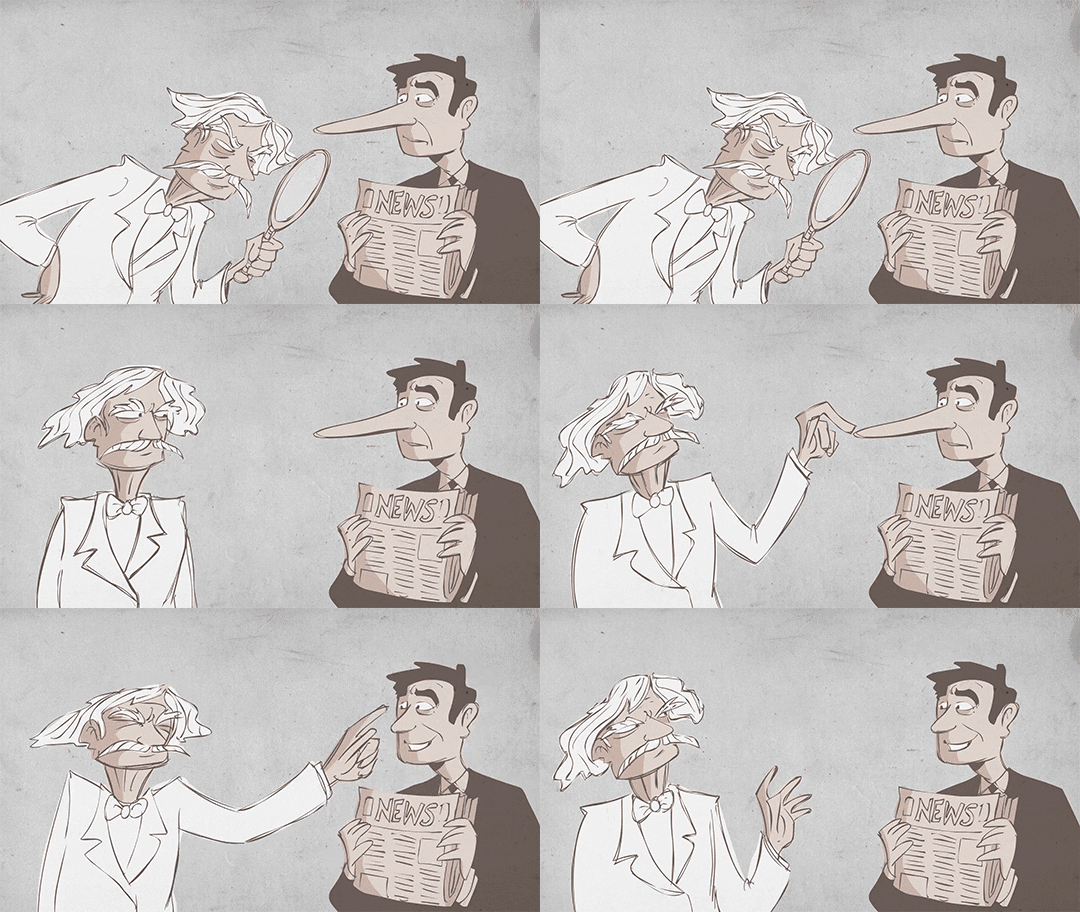
In November 2016, Stanford University researchers made an alarming discovery: across the US, many students can’t tell the difference between a reported news article, a persuasive opinion piece, and a corporate ad. This lack of media literacy makes young people vulnerable to getting duped by “fake news” — which can have real consequences.

image

Animation by Augenblick Studios

Want to strengthen your own ability to tell real news from fake news? Start by asking these five questions of any news item.


image

Animation by Patrick Smith

Who wrote it? Real news contains the real byline of a real journalist dedicated to the truth. Fake news (including “sponsored content” and traditional corporate ads) does not. Once you find the byline, look at the writer’s bio. This can help you identify whether the item you’re reading is a reported news article (written by a journalist with the intent to inform), a persuasive opinion piece (written by an industry expert with a point of view), or something else entirely.

image

Animation by Patrick Smith

What claims does it make? Real news — like these Pulitzer Prize winning articles — will include multiple primary sources when discussing a controversial claim. Fake news may include fake sources, false urls, and/or “alternative facts” that can be disproven through further research. When in doubt, dig deeper. Facts can be verified.

image

Animation by Martina Meštrović

When was it published? Look at the publication date. If it’s breaking news, be extra careful. Use this tipsheet to decode breaking news.

image

Animation by Augenblick Studios

Where was it published? Real news is published by trustworthy media outlets with a strong fact-checking record, such as the BBC, NPR, ProPublica, Mother Jones, and Wired. (To learn more about any media outlet, look at their About page and examine their published body of work.) If you get your news primarily via social media, try to verify that the information is accurate before you share it. (On Twitter, for example, you might look for the blue “verified” checkmark next to a media outlet name to double-check a publication source before sharing a link.)

image

Animation by Augenblick Studios

How does it make you feel? Fake news, like all propaganda, is designed to make you feel strong emotions. So if you read a news item that makes you feel super angry, pause and take a deep breath. Then, double-check the item’s claims by comparing it to the news on any three of the media outlets listed above — and decide for yourself if the item is real news or fake news. Bottom line: Don’t believe everything you read. There is no substitute for critical thinking.

image

Animation by TED-Ed

If you get in the habit of asking all 5 of these questions whenever you read a news article, then your basic news literacy skills will start to grow stronger. However, these are just the basics! To dive deeper into news and media literacy, watch the TED-Ed Lesson: How to choose your news. To find out more about what students need, read the Stanford University report, published here.

image

Animation by Augenblick Studios

Laura McClure is an award-winning journalist and the TED-Ed Editor. To learn something new every week, sign up here for the TED-Ed Newsletter.