The lexicon—the “words” available for use—is small (maybe a dozen commands). But, Queen says, the whistles have what are called sign relations. They can be symbolic, where the sound doesn’t have any connection to its meaning. But they can also be iconic (where you can sort of tell what they mean from their form). And even more language-like, they can also be indexical, where the meaning changes depending on how you use them. But here’s the really cool part: Shepherds vary the whistles’ rhythms, pitches, speed, and volume, and “each of those variations provides different kinds of information about what the dog should do,” Queen says. That’s called “prosody,” and it’s a key part of human language.
Just as you might speak more loudly and clearly if you think someone doesn’t understand you, a shepherd will more clearly and slowly blow a command if the dog seems to hesitate. Higher pitches attract attention. A faster whistle tells the dog to speed up, even if they haven’t been trained to do it. (That’s “iconic meaning.”)
When commands have to come faster or more urgently, handlers simplify and remove the parts of the shared language that they don’t need. Queen says this is an example of “metapragmatics,” or speakers understanding how to use their speech. This communication system has none of the “who’s-a-good-dog-yes-you-are” cooing that you might hear between a dog owner and its pet. “Shepherds don’t think of their dogs as little furry people. They understand them as dogs,” Queen says. “It’s this really interesting question of, how do you communicate with a species that doesn’t share your communication system, that doesn’t share your kind of mind?” The answer, roughly, is that anything that might convey whether the handler thinks the dog is doing well or poorly gets cut. “Those parts of language that the dog can’t understand—because it’s not a human—come out.”
“After discovering embroidery from her Grandmother and then being fascinated by the French knot, ipnot has spent years perfecting her hand-embroidery art and today creates “paintings” using just needles and yarn.”
Working with a collection of 500 different colors and shades of yarn, ipnot creates everything from bowls of soup and sushi rolls to fruits and vegetables to chocolates bonbons and more. Each tiny creations is remarkably realistic.
Our favorite piece is this embroidered miniature matcha, which actually looks frothy and ready to drink:
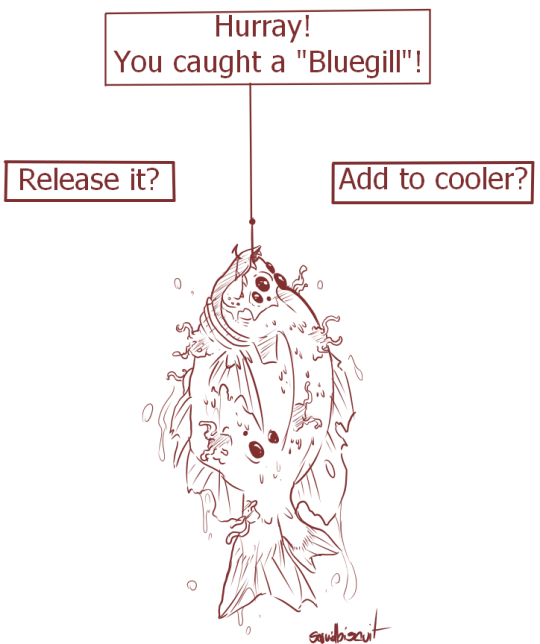
A game that is marketed as your standard fishing game and for the first 20 minutes or so you catch normal fish like bluegill and bass and what have you. But the further you go into the lake you start to catch fish with mutations and it gets more and more intense until you’re pulling in Eldritch horror monsters and sometimes severed human limbs. You realize you don’t recall how you got to this lake in the first place and the objective becomes to find your way back to shore. You have no real weapons but you can throw the creatures you’ve caught far away from the boat as a means to distract whatever is underneath you, bumping into the boat sometimes.
Additional items for the game.
A fishing pole with a radar that starts out with just beeps but later includes noises with hidden messages.
A GPS that displays texts and story elements.
You meet other boaters, all from various backgrounds, countries, and time periods. Some are friendly, others want to sacrifice you to the lake monsters.
You can also take the route of sacrificing others to the lake monster.
Or you can assemble a party and work to keep them safe.
The more fucked up looking the fish you catch, the closer you’re getting to a boss fight, which is usually running from something you can only see part of in the water.
????
And that’s my game idea.
More details.
It never stops being a fishing game. You are always fishing and searching for new areas where there is more activity in order to progress the story.
Depending on the choices you make and the amount of mutant fish you consume, you may start to mutate yourself. The fishing pole is part of your arm, you don’t notice it until later. If you consume mostly non-mutated fish and don’t sacrifice to the monsters you can keep the mutations to a minimum.
You can go full mutant and the boat becomes part of your body as well. This makes the monsters pay less attention to you, but you can no longer befriend or trade items with humans. You can still catch human remains and most of them are carrying items.
If you stay mostly human you can work to gather as many surviving humans as you find and assemble a fleet. The possibility of one of them turning on you always stands.
If you’re mutant you gain the ability to capsize yourself and view things under water. This is how you find ultimate monster.
If you’re human you can explore small abandoned docks and islands. These are where you find portals leading to different time periods and countries. You deliver members of your party to these. Only the person who originally belongs there can go through it.
Possible end game situations.
You find the portal leading back to your world, where you wake up on the river bank. You can catch normal fish before going home, making sure they are all free of mutations (they might not be.)
You join the monster, eventually overtaking it. You gain the ability to open time portals near water. You use lures to draw in humans.
I can’t think of anymore endings right now, I may have ruined the game with these new details so feel free to just enjoy the first part.
Terrible concept art. Mini game idea. Compete with members of your party to catch the most fucked up fish. Points awarded based on how many extra body parts it has and if it communicates telepathically with you.
Added my No-Romo posts to this because I feel they are the most important additions. (I am not a writer or game designer or really capable of making anything so this idea is just wishful thinking at best.)
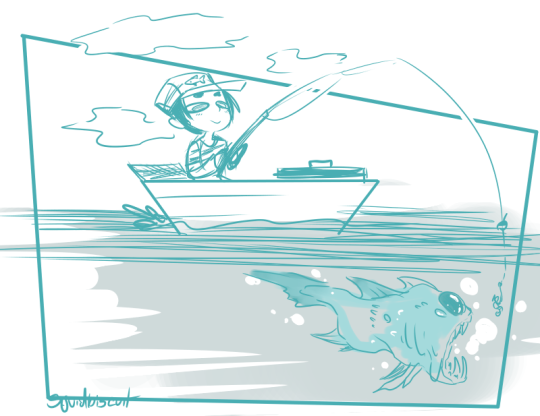
Concept art if it was a more stylized, cute game. You would be able to customize your character and your boat. Sorry this became so big I’m tagging it with it’s working title “Lure” for now. I legit expect nothing at all to come from this, I just like to design and concept out things a bit.
Okay, I fully understand everyone’s excitement over the ring-exchange and engagement, but please don’t mock or dismiss Yuuri calling it a “lucky charm”.
Not only were those his honest and sincere feelings, but omamori are more than mere “lucky charms”, they’re a huge part of Japanese culture, and Japanese religion, with very profound meaning, so mocking that is actually incredibly rude, and highly culturally insensitive.
Traditionally, Japanese omamori look like this
and can be bought at most shrines and temples in Japan. I’d actually say they’re closer to “prayers” than “lucky charms”, really, in their intent, though that doesn’t quite fit, either. But when you know that the most common omamori are for things like safety in traffic, doing well in school, having romantic encounters, and fertility/safely born children (used both by couples who want kids, and expecting mothers hoping for no complications with their pregnancy), you probably see what I mean.
The word omamori translates roughly to protector/protection/protective charm, and are based on the animistic Shinto world view. The ones you get at shrines are part supplication that the enshrined deity will bless and protect you, and part a… hmm, almost a signal beacon? so said deity can find you, to know that you’re someone under their protection. And also part comfort for the carrier, that they’re not alone, that they’ve got someone on their side.
But it’s not just “official” deities that are considered to have protective powers. Your ancestors are also seen sort of as guardian spirits protecting their family line (common theme in East Asian religions – Mulan, anyone? – at least, and I think also in all animistic religions, though that’s not my area of expertise), and even such ambiguous things as strong emotions are seen to have protective and blessing properties, especially love and affection.
For this reason, a lot of people will use mementos or objects of sentimental value as omamori. Either because it reminds them of a particular person or situation or emotion, or because they see some kind of link between that particular object and whatever they seek blessings for/protection against.
The important part for Yuuri, and why he bought that ring, is less that it’s a wedding ring, and more that it’s a gold ring. Yes, emphasis on both gold and ring.
The gold part is obvious, because the blessing he wants is help in getting a gold medal. It’s a resonance/like-brings-like thing.
The ring part is more obscure, but I’ll try to explain it.
One of the most basic and important parts of Japanese culture and society is the idea of 縁 (en). If you look it up in a Japanese-English dictionary, you get words like fate, destiny, chance, a relationship, a connection, a bond, an affinity, and while those are all ways to translate the word, depending on context, they don’t really explain the concept. En is the meeting of two or more things/beings that leaves a lasting connection or bond.
You might say you don’t have en with money to indicate that you can never seem to amass any wealth. It’s less you’ve got no luck with money, but more that you and money were never meant to be. You might earn it, but it still doesn’t stick around, somehow. An omamori for romance is called an enmusubi, or a “tier of en/bonds”, in this case referring to interpersonal relationships.
If you’re saying goodbye to someone you don’t know whether you’ll ever see again, you might express a wish that you’ll have en, and be able to meet again.
Now, I’ve mentioned in previous posts that the Japanese love homonyms and word associations. This is even more true for en, because it’s so important to them. Like in the example of a farewell, you might give someone a five yen coin, because five yen is go-en (五円), and when speaking of en with an honorific, that’s also go-en (ご縁). It’s a physical manifestation of your wish to have en with them. This is also why five yen coins are generally considered the best coins to give as offerings when you pray for something, despite their low value, because it indicates a hope for en with your wish.
Okay, getting to the point now: Another homonym (well, technically the same one, but different usage) for en is the word for circle or round. And because that’s basically what a ring is, rings are often used as a metaphor for, or an expression of a wish for en. So rings generally have a more profound level of meaning in Japanese.
It’s a gold ring because Yuuri wishes to have en with gold medals. He gives it to Victor because he wishes to have en with him.
He spent the whole day looking for something. He said he’d desperately wanted an omamori for a long time. He’s embarrassed, because yes, it’s a goddamn wedding ring, and he’s very aware of that, and giving rings to someone, period, is not something a Japanese person does lightly. It’s a very meaningful act, and this omamori is very important to Yuuri, so going “lol, lucky charm, yeah right” is incredibly disrespectful.




 blackash26