I believe that line is meant to be the all-encompassing theme
for the show. Everything comes back to Love.
It’s about Victor and Yuuri’s love, from their first dance to
the blossoming of their friendship to the exchange of rings. It’s about the way
Yurio and Yuuri inspire each other to aim higher and higher. It’s about Eros
and Agape. About looking outside of yourself and realizing there is love all
around you. About finding inspiration in others. About motivating others and in
turn, being motivated yourself.
It’s
about learning that you don’t have to fight alone.
It’s about Minami looking up to Yuuri and striving to improve
his own performance to catch up to him. About Victor and Yurio finding their L
words. About Yurio’s love for his grandfather. About katsudon-stuffed pirozhki. About Hasetsu’s love and support
for Yuuri. It’s about Yuko, Nishigori, and Minako-sensei doing everything in
their power to help Yuuri succeed. It’s about Mari and Yuuri’s parents working
hard at home so he can keep skating.
It’s about Georgie learning to let go of something that isn’t
working and looking to the start of a new relationship. About Sara putting her
foot down with her brother and establishing healthy boundaries. About Yakov
wanting the best for his “kids” and pushing them to succeed. About Phichit’s
dream of having all his friends skate with him in a big show. About JJ’s fiancée
singing her heart out to let JJ know he has her love no matter what.
There’s too much to put into one post.
It’s that abstract, all-encompassing love that Yuuri talked
about when he announced his theme for the season. “Love on Ice” represents the show as a whole. It’s an entire community of people blessed by what’s happening on
the ice.
Okay, I fully understand everyone’s excitement over the ring-exchange and engagement, but please don’t mock or dismiss Yuuri calling it a “lucky charm”.
Not only were those his honest and sincere feelings, but omamori are more than mere “lucky charms”, they’re a huge part of Japanese culture, and Japanese religion, with very profound meaning, so mocking that is actually incredibly rude, and highly culturally insensitive.
Traditionally, Japanese omamori look like this
and can be bought at most shrines and temples in Japan. I’d actually say they’re closer to “prayers” than “lucky charms”, really, in their intent, though that doesn’t quite fit, either. But when you know that the most common omamori are for things like safety in traffic, doing well in school, having romantic encounters, and fertility/safely born children (used both by couples who want kids, and expecting mothers hoping for no complications with their pregnancy), you probably see what I mean.
The word omamori translates roughly to protector/protection/protective charm, and are based on the animistic Shinto world view. The ones you get at shrines are part supplication that the enshrined deity will bless and protect you, and part a… hmm, almost a signal beacon? so said deity can find you, to know that you’re someone under their protection. And also part comfort for the carrier, that they’re not alone, that they’ve got someone on their side.
But it’s not just “official” deities that are considered to have protective powers. Your ancestors are also seen sort of as guardian spirits protecting their family line (common theme in East Asian religions – Mulan, anyone? – at least, and I think also in all animistic religions, though that’s not my area of expertise), and even such ambiguous things as strong emotions are seen to have protective and blessing properties, especially love and affection.
For this reason, a lot of people will use mementos or objects of sentimental value as omamori. Either because it reminds them of a particular person or situation or emotion, or because they see some kind of link between that particular object and whatever they seek blessings for/protection against.
The important part for Yuuri, and why he bought that ring, is less that it’s a wedding ring, and more that it’s a gold ring. Yes, emphasis on both gold and ring.
The gold part is obvious, because the blessing he wants is help in getting a gold medal. It’s a resonance/like-brings-like thing.
The ring part is more obscure, but I’ll try to explain it.
One of the most basic and important parts of Japanese culture and society is the idea of 縁 (en). If you look it up in a Japanese-English dictionary, you get words like fate, destiny, chance, a relationship, a connection, a bond, an affinity, and while those are all ways to translate the word, depending on context, they don’t really explain the concept. En is the meeting of two or more things/beings that leaves a lasting connection or bond.
You might say you don’t have en with money to indicate that you can never seem to amass any wealth. It’s less you’ve got no luck with money, but more that you and money were never meant to be. You might earn it, but it still doesn’t stick around, somehow. An omamori for romance is called an enmusubi, or a “tier of en/bonds”, in this case referring to interpersonal relationships.
If you’re saying goodbye to someone you don’t know whether you’ll ever see again, you might express a wish that you’ll have en, and be able to meet again.
Now, I’ve mentioned in previous posts that the Japanese love homonyms and word associations. This is even more true for en, because it’s so important to them. Like in the example of a farewell, you might give someone a five yen coin, because five yen is go-en (五円), and when speaking of en with an honorific, that’s also go-en (ご縁). It’s a physical manifestation of your wish to have en with them. This is also why five yen coins are generally considered the best coins to give as offerings when you pray for something, despite their low value, because it indicates a hope for en with your wish.
Okay, getting to the point now: Another homonym (well, technically the same one, but different usage) for en is the word for circle or round. And because that’s basically what a ring is, rings are often used as a metaphor for, or an expression of a wish for en. So rings generally have a more profound level of meaning in Japanese.
It’s a gold ring because Yuuri wishes to have en with gold medals. He gives it to Victor because he wishes to have en with him.
He spent the whole day looking for something. He said he’d desperately wanted an omamori for a long time. He’s embarrassed, because yes, it’s a goddamn wedding ring, and he’s very aware of that, and giving rings to someone, period, is not something a Japanese person does lightly. It’s a very meaningful act, and this omamori is very important to Yuuri, so going “lol, lucky charm, yeah right” is incredibly disrespectful.
I feel like Otabek has the aesthetic that Yurio likes. Otabek is effortlessly dangerous, punkish, and badass. Not to mention JJ is impressed by him and Otabek can shut JJ up in a few words without getting worked up.
He rides a motorcycle, wears a leather jacket and sunglasses, and has a really collected/cool persona. Yurio, for most of his life off-ice, has been trying to emulate that type of ideal through his personality and fashion.
Additionally, Otabek is ridiculously masculine and strong. His facial structure, body shape, and voice is also very bold and sexy.
CHECK THOSE FUCKING PECTORALS
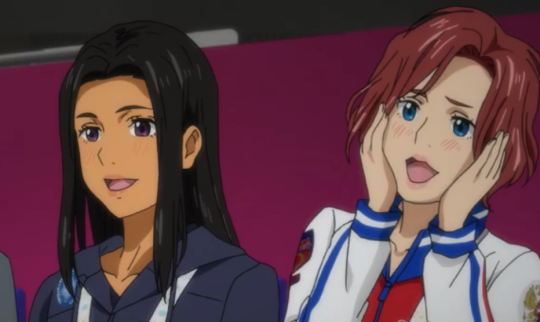
Physically, he is a contrast of Yurio, but also acts as Yurio’s ideal. I mean, my cat son wanted to skate to “eros” and the idea of eros/masculine and mature sexiness appealed to him but he really had none of those qualities (which isn’t a bad thing, by the way). BTW, check Mila and Sara’s fangirl faces seeing Otabek skate. Otabek is conventionally attractive/sexy.
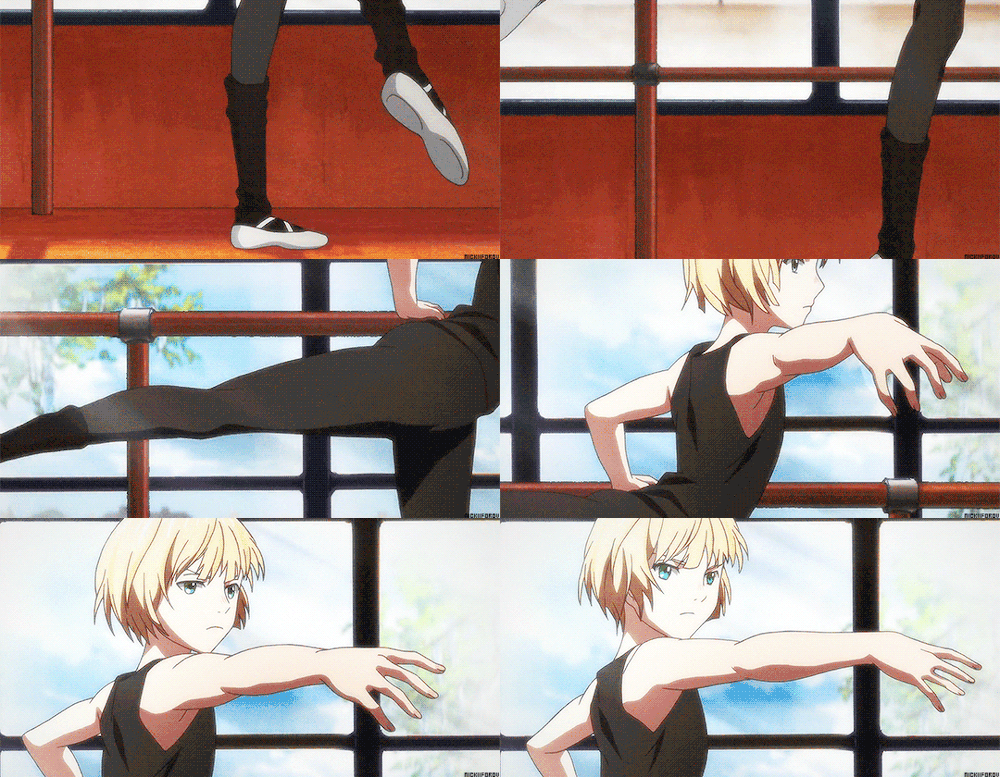
On the other hand, Yurio has the aesthetic Otabek likes. Otabek has always been impressed by grace. Yurio has both of those qualities (that he probably doesn’t even notice). Otabek’s most prominent memory of Yurio was when he was in the graceful, resembling a first arabesque, position at the ballet barre.
Graceful beauty and flexibility was and is something foreign and difficult for Otabek to express. In turn, Otabek admires these qualities in others. And who, other than Yurio himself, fully embodies such ideals, to the extent that he does, in YOI?
TDLR: Yurio and Otabek are each other’s physical ideals and complete the physical aesthetics that both want but don’t have. Mental ideal meta coming soon!
Further support for headcanon & how hilariously epic Victor’s sulk is.
It’s true that Victor was undecided between Agape and Eros for his next season, but the moves that he was practicing, the one that Yurio recognized immediately as being from his unfinished short program…….that was Eros.
Victor was planning to do a program about him getting dumped by Katsuki Yuuri in front of the entire world and probably win all the gold medals with it.
A season that he originally expected Katsuki Yuuri to be competing in.
Also when he was skating this, he didn’t expect Yurio to be there. He was more or less expecting just him and Yuuri, since this going to be the first day he and Yuuri will get to skate together.
HE WAS TOTALLY EXPECTING YUURI TO WALK IN AND SEE HIM SKATING THEIR STORY OF THE LOVE GAME.
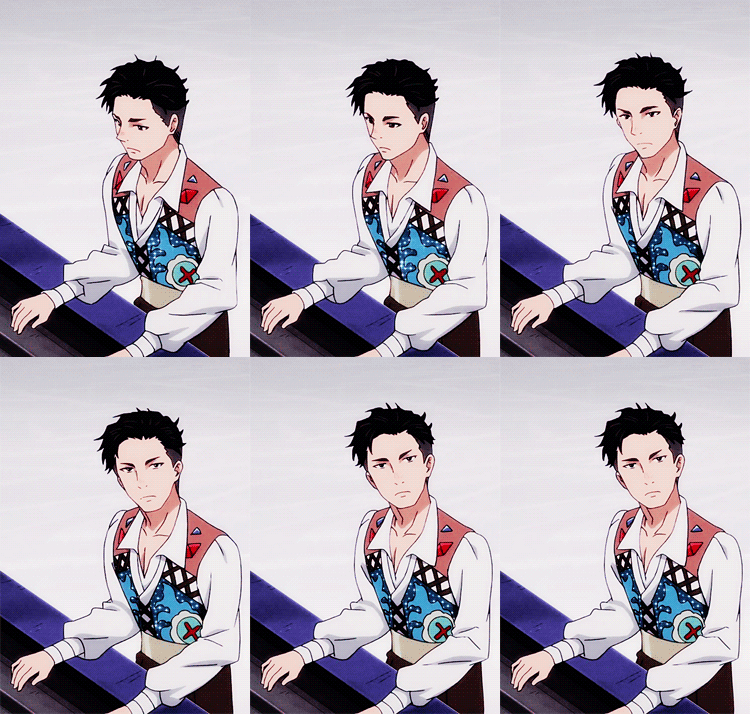
Also, this face.
THIS FACE MEANS SO MANY THINGS NOW, MAN.
jesus victor can you. not be so extra maybe for 5 minutes. thanks.
Wait. So if Victor was going to make Eros his SF next season and Yuuri was competing, Victor would have been the one grinning/licking his lips/blowing a kiss at Yuuri (when they’re in the same cup) and Yuuri’d be so confused?
oh my god the image of Victor in some fucking sexy outfit, licking his lips or blowing a kiss or fellating his own fingers while making UNCOMFORTABLE EYE CONTACT WITH KATSUKI YUURI who has no FUCKING CLUE what is going on.
Or rather the audience response to it, which is of people starved for sustenance shocked and tearful at being fed a decent meal: it’s not just that it’s a heartwarming queer love story, it’s a heartwarming queer love story set in a more humane (but not unbelievable) world, one populated by characters who are both colorfully drawn and basically good-hearted. There are no antagonists; no one is really malicious or cruel. This is not to say none of the characters ever screw up, because of course they do, but no one in the world of this story is trying to harm anyone else.
Maybe this is in part what @coloredink means by calling it a gift from the brightest timeline. What I’m seeing in the often semi-hysterical audience response–my own included–is that there’s a massive unmet need for this sort of gift. I don’t like to use the word “fluff” because I have a complex about it, which boils down to resentment toward its connotations of insubstantiality, and what Le Guin once said about the
bad habit, encouraged by pedants and sophisticates, of considering happiness as something rather stupid. Happiness is not stupid, and stories devoted to furnishing comfort and joy, and hope of love and a more humane world, need not be stupid or insubstantial. Comfort and joy are essential to life. Not just in the hellhole of a year that is 2016, but always.
There’s no reason we should be starved for stories like this.
This line is all very cute and witty and everything but I think Garak does believe it. I wouldn’t be surprised if most Cardassians believe.
Heres why:
In A Stitch in Time, Garak describes Cardassians experiencing all memories at all times. All of a Cardassians memories are experienced as the present. If this is true than one may presume that memories do not fade and distort to the same extent as human ones.
NOW here’s the thing about that.
The issue of perception and truth (in something less than a philosophical sense) is presented by scenarios such as those in the show Brain Games.
In this particular example its possible a Cardassian would notice the switch due to the memory of the previous clerk being present. However there are other instances that I can’t seem to find clips of things such as clowns on unicycles going largely unseen on a college campus.
Suppose two Cardassians were walking down a street and they were passed by a unicycle. Both saw it but only in their peripheral vision.
One noticed and got a good look at it and one did not. A good look can be nothing more than a slight movement of the eye, presuming that only a small part of the Cardassian feild of vision is finely focused, as it is in humans.
The first remarks about it to the other but when he turns to look it has already rounded a corner out of sight.
Both have a memory existing in their mind with the rest of their life’s memories in that moment. One features a unicycle. One does not.
The second Cardassian that did not see is left with only a few possibilities
his friend is lying to him
his memory is fake (unlikely to be accepted as a memory that is always experienced as the present would likely be clear as bell)
he and his friends had two distinct experiences of reality that are both experienced as Truth but are incompatible
It gets a lot more messy when you move to more complicated things.
You don’t remember shouting at your mom. She definitely does. Your memories are contradictory.
Now imagine EVERYTHING YOU HAVE EVER EXPERIENCED is subject to this.
You would have to assume everyone no matter how trusted is lying to you.
Or you have to face the fact every person you encounter experiences reality in a way that they perceive as truth and may not be compatible with your own.
Its the “is the blue you see the blue I see?” quandary expanded to all of reality.
If this is the case, its hardly surprising that Cardassians would not believe in an ultimate Truth the way the average Star Fleet officer does.
In terms of race and gender prejudice, the American wizarding world is more progressive than no-maj society. The MACUSA president is a black woman, there’s a woman of color on the Auror team, and Tina used to be an Auror.
Yet this all takes place within living memory of slavery, during a time of massive social inequality in the no-maj world. It makes you wonder: What about magical children born to no-maj families? The culture shock must be tremendous.
In no-maj society, women and people of color were second-class citizens in 1926. Meanwhile in the magical world, sexism and racism appear to be minor issues, but you’re forbidden from befriending any no-majs—a difficult feat for any muggleborns. It’s almost impossible to imagine how this works from a historical perspective.
What about magical kids who were born into slavery? Were they whisked off to Ilvermorny, the American Hogwarts, while their friends and family remained enslaved? Once they grew up in the magical world, were they expected to ignore the plight of people like themselves, and follow the MACUSA’s policy of non-interference in the no-maj world? In the context of a character like MACUSA president Seraphina Picquery, this raises a lot of troubling questions, none of which are even hinted at in the movie.
It’s usually done so humans are presented as “average”. In my conception, humans are the daredevils. The one thing a human loves more than watching another human do something horribly unsafe is doing something unsafe themselves.
It’s said that the stout and serious dwarves invented the first staircase, but it was a human who came up with the idea of surfing down the staircase on an oaken shield.
Elves have lived in the great Hometree overlooking the Mother River for untold ages. It was a human who first had the idea to jump out of the tree and into the river.
That’s the other thing – dwarves are stout and hardy, but like the stone they came from, once they break, they’re broken. Humans recover impossibly fast by the standards of other races. They’re also the first ones to get up after an explosion or cave-in, with a cheerful “I’m okay!” They can’t take as much as a dwarf, but nobody beats humans at getting back up again and again and again for more punishment.
The Hobbits appreciate Human vigor, their good cheer, and certainly their lusty appetite for food and drink, but the utter glee with which humans will attempt to harm themselves or their fellows in a misguided attempt at “fun” is horrifying. Their rituals and celebration – they let themselves be charged by bulls! – are seen as a testament to human ingenuity, creativity, and utter lack of good sense.
The humans who are most highly regarded by their peers are those who excel at SOMETHING. Dancing, throwing, singing, fighting – humans love watching other humans be excellent at things, even something otherwise pointless and wasteful, like throwing knitting needles into melons.
They are, to a fault, resilient. No Elves would DARE return to a failed settlement. The land is cursed and the dead walk there. Humans will rebuild the same castle over again with the same standing stones.




 blackash26