“You just like She-Ra because it’s gay and body diverse and all women!”
Yup. I do. And here’s why:
I don’t have to watch every character get trimmed down to fit into some feminine archetype or another. I don’t have to watch their relationships get pruned, rewritten, carefully tiptoed around lest they come off as gay. Without homophobia and sexism as a perpetual critical eye, carving and rearranging and judging, always judging, always eager to box and to correct and to exclude, characters and art have room to breathe and innovate.
Catra and Adora’s relationship would not be so rich if not for its ability to evolve and grow beyond typical the typical barriers assigned to two girls, to let romantic subtext happen because they don’t need to hide it or queerbait or make it one of a handful of specific gay tropes. The Best Friends Squad would not be so well knit if there was an executive looking over and saying “Glimmer can be affectionate but not that much” or “We need more emphasis on Bow just being a friend”. When Glimmer cuddles with Adora in the pool or holds her gently, I don’t see the crushing silence of those girls in high school, the reminder that this was going to be completely platonic or else, that box that must be maintained. I just see two people, expressing affection, and letting the chips fall where they may because it’s okay where they end up.
The queerness and diversity of She-Ra is not a checklist, it’s a liberation. It’s freedom from all the tired old tropes and assumptions assigned to women’s personalities, aesthetics, and relationships both in media and out. It’s growth, it’s subversion, whatever you want to call it, it’s new and rich and ripe with potential.
So yeah. I like She-Ra because it’s gay. Die mad about it.
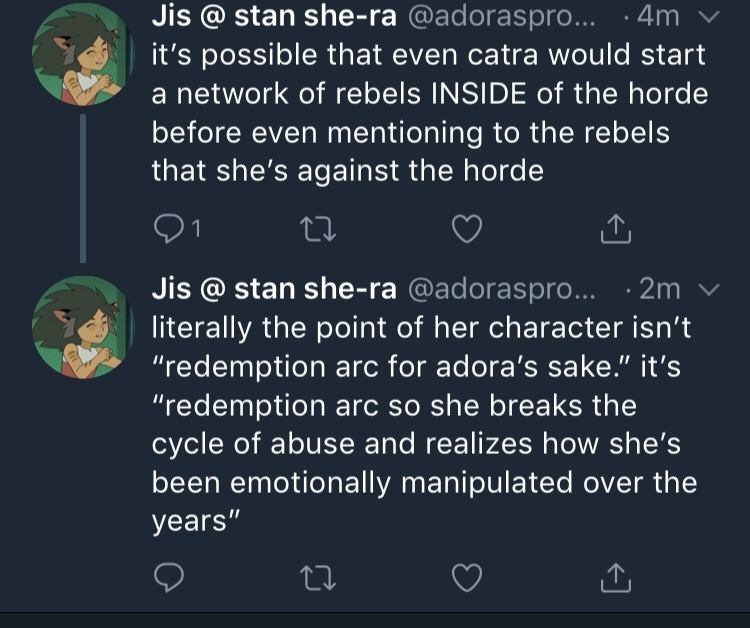
i’ve talked a lot about catra being the scapegoat, but now i want to talk about adora being the golden child. it’s not all sunshine and rainbows, that’s for sure.
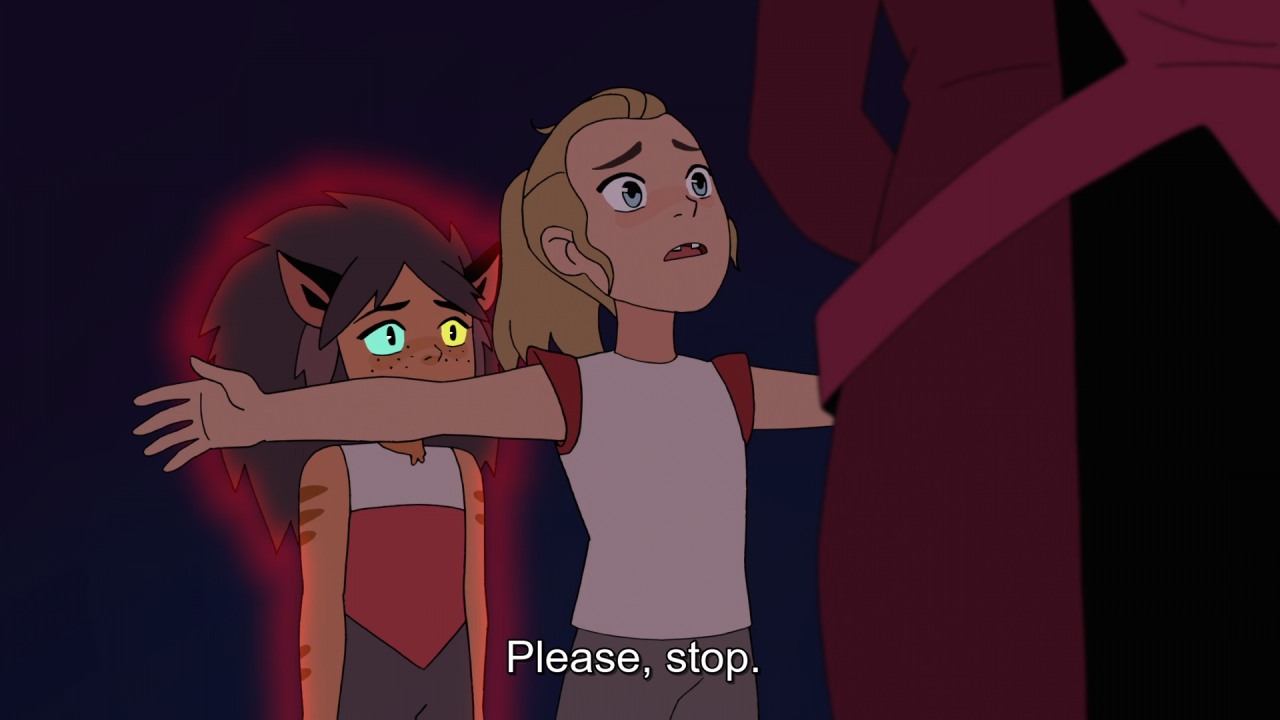
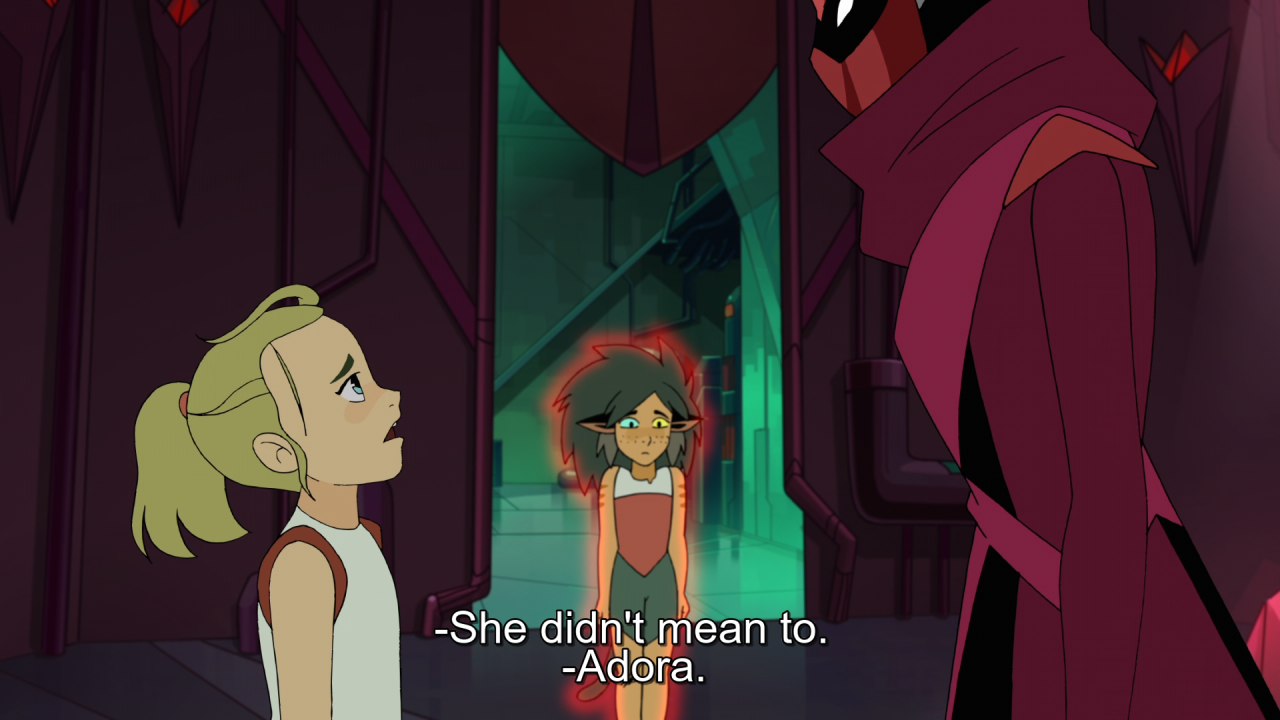
when adora was a child, shadow weaver told her that she was responsible for catra’s behavior, and by extension, her punishments. no, adora wouldn’t be punished for it, but catra would, and that was probably worse. this likely instilled the idea that, if catra got hurt because she “misbehaved” (read: did normal kid things), then it was actually adora’s fault–not catra’s (which it isn’t) nor shadow weaver’s (which it is). if catra suffered, then it was because adora wasn’t trying hard enough–to distract shadow weaver with her own accomplishments or convince catra to stay in line or whatever.
catra completely misinterpreted this, assuming that adora enjoyed this favoritism. is this the reaction of someone who enjoys being the golden child, or is this the reaction of someone who’s terrified?
a lot of people have assumed that adora’s behavior is arrogant, but i think it’s actually just…what she’s been told and taught–
–that she’s important, but not necessarily useful unless she’s doing everything the “right” way. sometimes, being important isn’t actually very comforting; it just gives you more power to make mistakes and let people down.
shadow weaver gave adora the illusion of control over more than her own behavior, and when that illusion crumbled, adora was left with…herself, and a sword. it’s no wonder that she clung to the sword as a source of validation and importance, a way for her to actually help people.
this also explains why she feels such strong guilt for anything bad that happens around her, which light hope recognizes and exploits. all adora wants to do is protect her friends (and, y’know, etheria–no pressure though), but what if she only hurts them? she’s convinced that she does have the power to save everyone, that she is important enough to do everything, and yet, she fails, again and again. even when she has the physical power to throw things around, she can’t heal plumeria’s tree or glimmer’s abilities, because she’s just not good enough.
being the golden child, being told that you’re special and amazing and perfect…a lot of people buckle under that pressure and end up paralyzed by fear that they can’t truly accomplish anything.
luckily, adora has found friends who truly do not blame her for not being able to save everyone, and she finds the strength to get up again and try.
one of my favorite things about the pokemon universe is how the humans are esp. the bad guys
like mob boss giovonni can pull out a glock and waste my 10 y/o ass but he doesn’t he just accepts that i knocked out his cat and hands me money
I have my own theory that humans in the Pokemon world don’t even have a concept of direct violence. They settle all disputes through Pokemon battles, but also a human without pokemon is entirely helpless. This might lend its self further to the notion that humans can’t venture outside of towns without bringing trained pokemon to protect them. Like, can Pokemon world humans even throw a punch? I think the notion of humans ever directly using violence against one another without pokemon involved is something they can’t even think of.
In one of the movies ash just straight up clocks lucario
ash is innovative in a world where humans can’t punch
*steeples fingers* okay so I know this is a humorous fun joke but like…
Let’s think about this for a moment.
Mob Boss Giovanni probably has a gun. Given the level of technological development in pokemon’s universe it’s very unlikely that nobody invented gunpowder or ever thought to put it together into a weapon, or that Giovanni would procure one.
Let’s also assume the average ten-year-old bright-eyed pokemon trainer is not wearing a bulletproof vest, or has particularly impressive gun dodging abilities.
Giovanni shoots child, Giovanni probably dies immediately.
do you ever get mad because there’s so much wasted potential in characters and relationships and plotlines in some shows
i basically divide up fandoms of continuing media into Fandoms Of Potentia and Fandoms Of Re.
i’m still developing this theory, but it sort of goes like this: there are some pieces of media that attract enormous followings not necessarily for what they are, but what the watchers think they could be, and build castles basically on those dreams of potential.
whereas a fandom of re is a fandom of what the work is, oftentimes a finished work to which no more will be added, which has proven itself in entirety.
And the interesting thing to me is that Fandoms Of Potentia are oftentimes bigger than Fandoms Of Re, bigger and more active, and there’s a couple of reasons for that – one is that a finished work leaves less room to add onto, and a finished work also leaves less need to add onto. The primary driver of fandom works is incompleteness, whether because the work is not yet finished or because it is finished in a way that the audience feels is incomplete.
Fandoms of potentia also have the bigger drama, because the fact is, not every content creator is up to living up to the potential the fans see. Creators are only human after all. So when the story doesn’t live up to the big finish the fans dreamed of, there’s a lot of disappointment, anger and hurt. You see less of that with Fandoms Of Re.
I guess where I’m going with this, is that whenever I see a huge fandom gathering for a work that I think is absolutely not deserving of it, I stop to ask myself whether it might be a Fandom Of Potentia. In which case, they’re fans of something I don’t see at all – they’re fans of the dreams of what might be.
Pippin: finally i’m getting the respect i deserve from these peasants
so accurate i am choking on my carrot. this is making me giggle harder than it should. I love Pippin so much.
I don’t think there will come time when I’m not reblogging this. Sorry guys.
no no no you guys don’t understand, Pippin is someone really important in the Shire! The books don’t talk about it a lot, and the movies won’t touch that stuff with a bargepole, but Pippin will be inheriting land rights to about a quarter of the Shire. He’s second in line to becoming military leader of all Hobbits. His dad is currently in charge of that stuff, but he’s completely aware of it, and educated for it, and that’s why he’s such an over privileged little shit in the books.
I thought it was a shame the movies didn’t talk about class differences in the Shire. Also puts M&P stealing food in an uglier light.
To be fair, at the time of the Party, Pippin would have been 12, which puts it back into a more acceptable light. And they’re stealing food from Bilbo, a wealthy and eccentric family member, which again makes things a bit different.
But yes, when they call Pippin Ernil i Perrianath – Prince of the Halflings – they are actually completely spot on.
And when Pippin tells Bergil “my father farms the land around Tuckborough” he’s deliberately downplaying his class so that he can greet the boy as an equal rather than a superior. It’s Pippin’s most adult moment in the series. Bergil is engaging in a status contest which Pippin can totally win – but instead chooses not to compete. Pippin is a gilded and spoiled lordling in the Shire, but he becomes a Man of Gondor.
Yeah, to add a bit of unnecessary trivia/level of preciseness, Frodo is the oldest of the four; he was born in 2968, was (obviously) 33 at the time of the Party, and so he’s 51 here. Sam’s second-oldest; born in 2980, he was 21 when Bilbo left and is 39 at this point. Merry’s two years younger than Sam, making him 18 or 19 in 3001, when the Party took place, and Pippin was born in 2990, so he was actually 10 or 11 during the Party, and during this scene they’re ~37 and ~29, respectively.
So yeah, Pippin’s the youngest by a lot. Plus, taking hobbit aging into account, he really is still in the equivalent of his teens; remember the Party was half to celebrate Frodo’s coming-of-age at 33, and Pippin’s around twenty years younger than Frodo.
This fucked me up. I didn’t read the books and in the movie it was shown like Frodo took off with the ring like 2 days after Bilbo’s gone away, but it was 17 years after that. OMFG.
Also worth noting that “Merry and Pippin stealing food” isn’t in the book – raiding Farmer Maggot’s fields, specifically the mushrooms, is something Frodo used to do when he was a kid, before his parents died and he moved to Hobbiton to live with Bilbo. Frodo’s still afraid of Maggot’s guard dogs, but the farmer himself is sympathetic and helpful when he finds Frodo & Co. cutting through his field.
And this is specifically invoked in the books at the Council of Elrond, where Elrond argues against Pippin in particular going, because he is so young. He’s okay with Merry going but wants to keep Pippin in Rivendell. Elrond has serious misgivings against sending an early-teenager off to face the Shadow, and given what happens to Pippin in The Two Towers, he was not wrong.
Merry is also a prince of sorts – his father is Master of Buckland, which is the semi-autonomous boundary community between the Brandywine river and the Old Forest (never, alas, discussed in the movies). Merry and Pippin are friends in the books in part because they’re of relatively equal status and in part because they’re cousins (like all nobs, Shire nobs mostly marry each other).
However, the books also clearly make Merry the Responsible One, even though he’s only been a full adult for four years. (Think early 20s in human terms.) Merry buys and prepares the house at Crickhollow. Merry figures out the secret of the ring before Bilbo even gives it to Frodo, but Merry keeps Bilbo’s secret. Merry convinces Sam to spy on Frodo. Merry explains that they’re all joining Frodo on the Quest, whether Frodo wants them to or not. Merry cautions about the Old Forest and doesn’t go down to drink in the taproom at the Prancing Pony.
So in the books, Merry isn’t Pippin’s partner in pranks – instead, Merry and Pippin spend all their time together on the Quest because Merry’s looking after his younger cousin. Can you imagine what his mother would say if he came home without Pippin? Merry can, and that’s why he takes some pretty absurd personal risks during the books to make sure that doesn’t happen. Like, he literally rides into battle on the back of someone else’s horse, in disguise, because Pippin is probably somewhere in that battle.
Merry is 99%* common sense unless Pippin is involved, and then he is 100% save/rescue/protect/support Pippin. The character growth and maturation we see in Merry in the movies isn’t in the books; instead he has almost the exact opposite arc of becoming an extreme risk-taker, driven by his protective instincts.
(*The other 1% stabbed a ringwraith in the calf that one time, but we can argue that this was due to a natural expansion of Merry’s protective instincts toward Eowyn, with whom he’d bonded quite a lot recently, and toward Theoden, who he deeply respected as being kind of like his dad.)
bonus kleenex moment:
when pippin finds merry stumbling half-blind and sick through the streets of Minas Tirith after killing the Ringwraith, he tells Merry “Poor old fellow! I’ll look after you,” half-carries him to the healing halls, and is worried sick about him until he can finally get Aragorn in to give him medicine.
It’s the first time in the story that Pippin has looked after Merry, instead of the other way around.
It shows that Pippin has grown up, that he can protect the people who always protected him.
I love, I fucking love, that there’s this bit in the comics when Cass has her own apartment, and it turns out that Alfred has been coming over to dust, and wash, and do her laundry, and stock her fridge, and she has no clue. We find this out when she stumbles across Alfred mid-chores, and ambushes him.
Alfred tells her what he was doing there, explains that he’s being doing it for awhile, and asks Cass if she didn’t wonder how all of this was happening, and she more or less shrugs and says, “Nope!”
Cass never thought about any of it.
Basically, Cassandra Cain is like one of those pampered teenage boys whose mothers have always cooked all their food, cleaned their clothes, picked up after them, and generally eased their way in life, except that she’s coming at it from completely the opposite direction.
No one took care of Cass. Cass never had a real home. Cass doesn’t know what a household really looks like, not from the inside. Cass doesn’t understand domestic labor. How could she? David Cain probably took care of clothes and food when she was a little girl – he wouldn’t have diluted his vision for her as the ultimate assassin by having her do domestic work – and she spent all her days after Cain living in the shadows: homeless, nameless, wordless.
To Cass, the apartment that Alfred quietly maintained was probably like the one that Keir Dullea had at the end of 2001: A Space Odyssey: inexplicable (magic, or technology too advanced to be distinguished from magic). Aliens swooped in and provided Cass’s material needs, forever. For once in her life, she didn’t have to worry about food or shelter; she could just go out and do the only thing she ever wanted or knew how to do: save people. Preferably, by kicking the asses of the kinds of people who put other people in the position of needing to be saved.
Cass didn’t know how food was grown, cooked, and brought to her; she didn’t know how clothes were picked up off the floor and washed, and folded, and put away; she probably never even noticed dust, or whether it had been removed.
Cass knows so much, and so little. She understands profound things about the human spirit, about how and why we exist, about how people should be, what they deserve from each other. Cass will also would ruin your favorite pair of jeans with a bottle of bleach, if she ever got as far as the laundry room. (She wouldn’t. Cass doesn’t know what laundry is.)
– further on what is art: the viewers are interpreting this as art, but the intention of the “artist” was not actually art, so is it art or not? who gets to decide, the viewers or the creator?
– the act of placing the glasses and watching the response (and the response itself being that the viewers treated the glasses as art) as performance art
like is this a critique of postmodernism? does the critique betray itself since (one could argue) the viewers interpreting the glasses as art makes them art? or is that so ridiculous that it doesn’t matter? i could go on
The intention of the “artist” was not actually art, but… their intention was to create a specific image for public display in order to evoke a reaction from an audience, and then to create an image of that in order to evoke a different reaction from a second audience.
okay friends, as ready player one comes into the crosshairs of cultural mockery (as it deserves), I would like to take a moment to speak about a very important thing:
ready player one is not bad fanfiction
I know this seems like a relatively minor point! like, really, who cares? but not being fanfiction is actually critical to ready player one. not only is it not fanfiction, but it’s actually the polar opposite of fanfiction. it is the anti-fanfiction. not being fanfiction is integral to its existence
so, some background! in case you don’t know, ready player one is the story of A Dude who lives in a crapsack world. I actually think the first third or so of the book is pretty decent? yes, there’s an overload of “look at how large my nerd penis is,” but the worldbuilding is kind of interesting and author ernest cline does a decent job of setting up the ways in which the world is shitty and how an online virtual world has become both an haven for and crutch to society
because that is the big thing here: there is an immersive online world called the oasis, and it is big and people spend a lot of time there because the world is garbage
the creator of this online world is another dude, who died and left a treasure hunt within the game, and whoever finds the treasure will get his vast fortune and all his assets. it’s a fine setup, and it allows the author to make his hobby as important to his fictional world as it is to him, because there is only one way to find this treasure: you must know The Most about eighties nerd shit
what this means is that ready player one is the epitome of curatorial fandom: fandom that is expressed by having encyclopedic knowledge of canon, of how things were made and what promotion was done for them and, well, facts. ready player one is concerned with putting pop culture on a pedestal and appreciating at how flawless it is
and there’s nothing inherently wrong with that, if you’re into it! but I cannot stress enough how much ready player one cares about the canon and defining what the canon is and what belongs to it. there is an actual argument between our protagonist and his friend about whether or not the movie ladyhawke is “canon,” by which they mean, “did the dude who created this treasure hunt like ladyhawke?” our protagonist likes it, therefore he wants it to be canon. it’s not enough for him to just like the movie, his enjoyment must be validated and elevated by this dude he idolizes. and (spoilers) in the end it is, so, like, good for you, bro
ready player one is proudly, aggressively, and oppressively non-transformative. that’s not a bug, it’s a feature. one of the single most baffling things things the protagonist enjoys, at least to me, is when, as part of the treasure hunt, he must reenact a movie. that’s it. that’s the whole thing. he is put into matthew broderick’s place in the movie war games, and he must do everything matthew broderick did in the movie at the same time and in the same way matthew broderick did it. he gets bonus points for nailing the same intonation and doing the same movements as broderick, and if he messes up lines or misses cues, he loses lives and, eventually, the game
now, I don’t know about you, but I am genuinely struggling to think of anything as boring as doing every single thing that the protagonist did in my favorite movie or tv show, exactly as it they did it, aside from maybe the parts where I get to kiss a hot person. and I say this as someone who really enjoys rewatching my favorite shows and replaying my favorite games! but, like, if you’re going to put me in a fully immersive recreation of my favorite world where I am playing my favorite character, I am absolutely going to be making some fanfic shit come to life there. I’ve already seen the movie, I don’t need to live it when I could go off book and make the decisions I always wanted to make, or try to see if I can make everyone bisexual and get them into a big orgy or something. like, the possibilities are endless here, right? they should be!
from what I can tell, it has never occurred to ernest cline that people might actually want to change their favorite media, or even that they could be interested in anything that isn’t on the page or screen. which, again, not everyone does fandom like that! but after the protagonist finishes his war games reenactment, he says that as soon as people find out about this marvelous “put yourself in your favorite movie and do it exactly the same way it happens on screen or else you lose” technology, it becomes wildly popular and I’m still just kind of like, is that really what people want? is that the dream?
so, yeah. when I say it’s important to emphasize that ready player one is not fanfic, this is what I’m talking about. ready player one is horrified by the idea of transforming works. ready player one cares about canon and only canon. ready player one does, admittedly, have scenes that look like a big cool crossover, because everyone shows up to a fight in their own favorite mecha, so you have, like, mecha-godzilla fighting the giant robot from the Japanese spider-man show, but it’s just window dressing. there’s no depth to it. these are literally skins, outfits that the characters put on
compare this to, say, kingdom hearts, which is actually licensed crossover fanfiction. in kingdom hearts, sora (nomura tetsuya’s original character, do not steal) meets up with donald duck and goofy and travels through various disney worlds on a ship crewed by chip and dale, the rescue rangers, having wacky adventures and trying to save both his best friend and mickey mouse from the darkness
(god, how did that game get made)
on his quest, sora interacts with various characters from disney and square enix properties, all of whom are retain their personalities and appear as (essentially) themselves. it matters that simba is simba and cloud is cloud; they’re supposed to be those characters, or alternate but recognizable versions of those characters. this is what professionally licensed crossover fanfiction looks like, and I’m not saying it’s what ready player one should have been, but it’s a simple way to highlight how uninterested ready player one is in thinking about characterization. the only reason it matters that a dude is in mecha-godzilla is that he has the powers of mecha-godzilla in combat. it’s the ultimate “who would win” fantasy because it’s focused entirely on power levels. would superman beat goku, but without any consideration as to why they were fighting in the first place or what they as characters bring to the mix
and the reason I think this is important to talk about is that many male nerds HATE ready player one, and they don’t get to fucking put that on us. fanfiction is a female-dominated and largely stigmatized part of fandom, and I am not fucking letting the internet decide that the problem with ready player one is that it’s bad fanfic. ready player one would be an infinitely deeper, richer, and more interesting text if cline put any thought into transforming the works he reveres, instead of just describing what happens in them in loving detail
so you don’t get to blame fanfic for this one, nerds. this is peak curatorial culture. he’s one of you




 blackash26