I realize this is a cast iron gate but I’m choosing to believe it’s a magic protection ritual
It IS a magic protection ritual, and it summons an iron gate to protect you from intruders.
You have to enchant the iron so it protects against the fae.
This would work great in a visualization during the creation of wards, or protection magic.
i am so tempted to give people unsolicited metallurgy lesson
counter point, please give me metallurgy lessons?
im going to hazzard that either this isnt actually ‘iron’ iron, or if it is this will be one brittle fence
as theyre pouring it as a liquid and its actually -flowing- iron would have to be around 3,000 degrees F, or around 1,600 C. normal ‘cast iron’ is rather brittle, which is why most iron fences were ‘wrought iron’ as in they were extruded and hammered into bars and then hammered into shape.
the way to counter this would be to anneal it by only allowing the temperature to lower slowly over the course of, say for something this size, about three days. i can asess this isnt the case as live humans are present so the temperature of the room as a whole has to be somewhere below the boiling point
these two points are dude to the nature of iron- as all metals it has a crystal latice structure when solid, which gives metal their strength, however moreso then other metals iron and iron based alloys have a wildly different crystal structure and grain size (yes, grain like the grain of wood) which relies on things like max temperature, the rate of cooling, alloy metals, pressure, and so fourth. knowing the hundred bullshit ways to screw with the grain is how we do absolutely bonkers stuff with ferrous compounds
consider history- there was the stone age, the bronze age, and then the iron age. iron is the fourth most common metal on earth (any more common metals were not usable untill the electric arc furnace, such as alluminum) whereas copper is the 26th most common- therefore why was the bronze age before the iron age? because iron was extremely difficult to turn into a usable metal until the development of far better furnaces just to get it red hot and kinda soft, known as ‘bloomery iron’ or ‘tamahaganae’ if you live in japan- iron so impure you have to hammer it for days to remove all the residual crap that was still in the sponge of hot metal.
you may notice in this diagram your iron basically sits dirrectly on top of the charcoal for most of the history of iron, and ‘sponge is the right word.
after much development of bloomery furnaces a hotter method was invented
to make ‘pig iron’; reaching an almost liquid state where it could be
poured into bar molds like honey.
this was not exactly easy as anyone who has seen princess mononoke knows, and still the iron was fairly shit although vastly superior to the bloomery process. only small ammounts could be produced and what you did make was expensive due to the process. in greece for example during the afforementioned ‘bronze age’ iron tools existed, but were considered too valuable to use for weapons or armor which would be broken, lost, or siezed by an enemy. theyd rather make saws and chisels which could be handed down for several generations with what was to them a legendary metal. it wasnt untill the development of the blast furnace where heat retention and bellows were upgraded to actually create fully liquid iron for the first time- iron being fully liquid allows all the impurities stated before to just float off as a surface skum instead of having to be hammered out
this is where we have what we today would actually call ‘iron’ yet it still being unusable in its present form- it would produce fairly brittle bars of mostly pure Fe, with a crystal structure similar to that of a distressed saltine cracker.
because liquid iron that was cooled to room temperature, which is why shit like this in movies
looks fucking cool but would result in a sword that would snap in half when you swing it. not even wait till you hit something, it would snap in midair
and thats currently where the above fence would be- fully liquid cast iron cooled quickly enough it becomes a brittle crystal, you could snap bits off by hitting it with a baseball bat.
ive actually seen people do things like this and it had been an issue for a LONG time that many things were made of cast iron because it was the only way to make things of a certain size and shape, but they broke very easily- for example cast iron ploughs, which would crack when farmers hit a largish stone and then you had to drag your plough to a blacksmith. by replacing a fully cast iron plough with a plough that if the cast iron cracked you could remove and replace that part with a new one, and have the far smaller one repaired while you went back to work
earlier i used the word ‘anneal’, one of the ‘hundred ways to bullshit
with iron’ i mentioned, where by raising the irons temperature and then
cooling it very sloooowly the crystal structure is very minimal,
resulting in a soft metal that is far more impact resistant. which COULD
be an option, provided they lower they temperature of that metal by
less then a hundred degrees every 2-3 hours. typically annealing is done
by just leaving a metal item IN the furnace but turning the heat off
and then going home for the weekend. even leaving the furnace door open
would be cooling too quickly. again im going to say this is not what
theyre doing as live human beings are present so during the gif alone
the temperature fo that metal has dropped at least 500 degrees
so how do you make iron that isnt brittle? you do this
all the earlier ‘impurities’ talk- the sparks flying are the impurities leaving the metal, this his how before actually properly smelted pure iron you actually got to make a usable tool. hammering the still hot metal also changes how the metal is formed on the inside, no not by folding but simply by adding pressure to squeeze everything into alginment. but we today dont have a whole lot of blacksmits because weve instead changed to putting the metal through satans own playdough machine
no, wait, not enough satan
THERE we go
so now with our knowlege of infernal devices just spitting out refined metal, and by quality control of knowing what goes in we can do some dark wizardy in alloy production that would require me a week, overhead projector, and assorted test samples to demonstrate why i have to specifically use the word ‘bullshit’ for what you can do with iron.
how ive seen wrought iron fences made- you aquire some of the iron billets produced by the machinery, cut them to lengths, heat untill glowing, and make like a fire god shaping hard candy. theres even tools specifically for this
it is however entirely possible that the fence they poured wasnt made out of actual iron (or is but it is in fact stupid brittle), or perhaps some alloy that will not become brittile or explode by doing it that way. im leaning more towards this but then it raises more questions as to what material they chose. if i could see the finished product i could probably answer that, but at that point you could just ask someone what they did
Bard: Some cultures believe that the Creator sang the universe into existence, which is both correct and completely literal. Using scraps of divine melodies stolen from those few beings old enough to have heard them first-hand, a bard beguiles and bamboozles the very fabric of Creation into carrying out her wishes – in essence, successfully impersonating God. (This is why bardic spells depend on Charisma – when running a con job, projecting confidence is more important than getting the fine details right!) Demonstrating bardic magic in the presence of angels and other celestial beings is not recommended.
Cleric: Contrary to popular belief, clerical magic does not flow from a divine patron, nor from the cleric’s own belief in her principles; there are clerics dedicated to philosophies with no identifiable deity, and even a few clerics who believe in nothing at all. Rather, clerics are able to perform miracles because other people believe they can. The humble village priest’s power is limited by her small audience, while the truly mighty cultivate reputations known by millions. Many of the most powerful clerics are hereditary monarchs, trading on the fact that “everyone knows” the hands of a King are the hands of a healer. Confusingly, the gods do exist, but have nothing to do with the magic of their self-appointed representatives.
Wizard: “Spells” are living – albeit intangible – creatures that the wizard induces to inhabit her brain. They produce magical effects on demand as payment for the wizard’s cranial hospitality. High-level wizards learn to cultivate more spacious and luxurious mental accommodations, allowing them to house both larger numbers of spell-creatures and more demanding ones. While most low level spell-creatures are essentially interchangeable, high level spells (particularly those of 6th level or greater) may be named individuals with distinct personalities and opinions; a wizard who repeatedly prepares a particular spell may end up with the same entity over and over again.
so i saw some people discussing how loki in ragnarok shouldn’t have been at all phased or subverted by dr. strange – which i agree with, but also, hey, it’s comedic and you can argue that he was taken off-guard, but upon re-watch, something stuck out to me –
there’s this moment when they appear at the bottom of the stairs and thor rolls down the last couple and stands up and he says
we could’ve just walked.
and it made me think of how magic works in terry pratchett’s novels, how (to paraphrase) the hard part wasn’t turning someone into a frog, it was not turning someone into a frog when you knew how easy it was.
like, the whole scene with dr. strange is just. all magic. all pointless magic. unnecessary magic, when, well. they could have just walked.
whereas loki doesn’t really rely on magic overmuch in the movie – he uses it as a tool, when he needs it, but if the job can be done with plain old non-magical trickery or a knife, he just uses those. he resorts to magic when he’s cornered by valkyrie, he uses it when his goals are most directly accomplished by using magic rather than by other means.
whereas dr. strange is using magic all over his scene, just to use it. just because he can. magic was unnecessary for ninety percent of what he did in that scene, the only time he needed magic was to whisk them away to norway. but he teleported all over the place even when he only needed to move a few feet, gave thor an ever-refilling beer that just spilled everywhere, floated around to make a show of how ~magical~ he was, when…
he could have just walked.
i mean, i’m very sure that the filmmakers intended it for comedic effect, but there’s also a layer there of dr. strange being much less comfortable with magic than loki is – loki doesn’t need to bust out the magic at every opportunity, it’s simply a skill, a tool that is completely under his control and at his disposal. whereas dr. strange (at least in his scene in ragnarok) is showing off, which reeks of insecurity.
i guess i’m thinking… if you take the magic away, loki is still a deadly, formidable opponent with many tricks up his sleeve, but dr. strange is just a guy in a cape.
Concept: a robot who is very, very obviously a powerful wizard, but always has some complicated explanation for why what they just did wasn’t magic, and frankly they’re shocked that you would be so credulously superstitious as to believe that it was.
Off the top of my head, there are at least two routes here.
First is “any sufficiently advanced technology is indistinguishable from magic”. Our robot wizard isn’t using magic, they’re using advanced nanotechnology, energy field manipulation, or some other utterly fantastic technology and scientific knowledge to perform feats that are nigh magical to the rest of the party. Either this is the result of advanced technology performing feats that are very similar to magic spells but are fundamentally different (manipulation of natural phenomena instead of supernatural forces), or superscience and magic ultimately do the same thing but approach it from a different angle. The natural philosopher class from the Northern Crown campaign setting of 3rd edition D&D is an example of this.
The other route is “any sufficiently studied magic is indistinguishable from science”. In this scenario, magic is not supernatural but just another type of natural phenomena. It has rules and laws that can be observed, understood, replicated, and harnessed. This is where you will find mass-produced magitech. In such a scenario, discussions of what is science and what is mere magic and superstition quickly becomes an exercise in pedantry.
Of course, this is more of a spectrum. The robot wizard insisting that they are using science and not superstitious nonsense might be just as close-mindedly stubborn regarding the true nature of the world as the character they are arguing with who is convinced that they’re using supernatural magic.
Two other possibilities you’ve overlooked:
1. The robot is using perfectly explicable technological tricks; they merely like to wave a wooden staff and chant in Latin while they’re at it for the Aesthetic.
2. The robot really is an old school bell-book-and-candle wizard, no “sufficiently advanced magic” about it, and they’re just insisting that there’s a perfectly mundane explanation for everything they do in order to screw with people, like:
“Okay, I’m pretty sure you just summoned a demon there.”
“Nonsense – it was clearly a trained animal in a fanciful costume. I’m surprised you didn’t know that I dabble in exotic animal husbandry, I’m sure I’ve mentioned it before.“
“And the part where it popped out of a spontaneously manifesting ring of green fire?“
“Aurora borealis.”
“Wait. You just turned that person into a newt. Don’t tell me that wasn’t magic.”
“Indeed it wasn’t. It was retrograde evolution, induced by a simple dose of reverse RNA transcriptase surreptitiously administered via hypodermic dart – any schoolchild could explain the underlying mechanism.”
“That’s… that’s not. How evolution. Works.”
“Well, listen to Mister Science Guy here! Which one of us is a walking marvel of modern technology, again? I think I know a thing or two about your primitive meatbag biology!”
“I… you…“
Option 4: it’s magic and he’s incredibly embarrassed about it because he’s a robot and it feels like he’s letting down the team. This is closely related to 3, but he does not in ANY way try to explain it, and in fact desperately avoids any discussion about it. “It’s science, very scientific,” he insists as Prince Vassago fistbumps him and helps him find his keys.
A witch curses a man to be a hideous, terrifying monster – only his learning to love and earn that person’s love in return will break the spell.
One day he finds an orphan in the land surrounding his home and takes the kid in. And yeah, he’s scary and horrible-looking, but like hell he’s letting a child out to fend for themselves, and he does everything he can to make sure the kid is safe, comfortable, and happy. And eventually the child stops minding that they’re staying with a monster, eventually stops thinking he’s going to eat them and gnaw on their bones.
And then one night the kid kisses their monster-dad on the cheek before bed and says “Goodnight, Dad. I love you,” thus breaking the spell.
But @twinklecupcake, how’s the kid going to react the next day when monster dad is now human dad? Monster dad is going to need to prove that it’s still him to the child.
Tbh I imagine it more like Disney and later takes on the tale, where the change is instantaneous. (As opposed to the Villeneauve version where it happens the next day.)
Still hilarious though.
“AAAAAAH, WHO ARE YOU AND WHERE’S MY DAD?”
“Kid, kid, it’s okay, it’s me! You – oh my god, you broke the spell-”
“WHAT SPELL? WHERE’S DAD?”
“Okay, kiddo, I need you to calm down–”
“*grabs the fire poker* Stay back! I know how to use this, asshole–!”
what if magic was real but it was treated the way music is now with different genres and like “oh youre still into conjuring? thats cool I guess. recently ive been getting into third-wave post-necromancy, it’s some pretty heavy stuff”
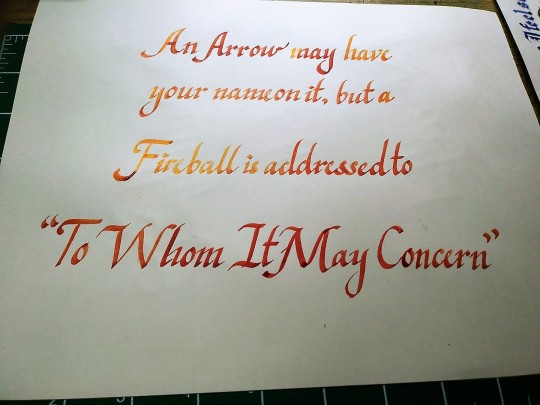
“what do you mean you’ve never learned FIREBALL, it’s a CLASSIC” “idk I’m not really into evocations.” “how can you not be into ANY evocations?” “well, it’s kind of dad magic, isn’t it?”
John Cage invents a “Silence” spell that last just over four and a half minutes.
It is done! The Modern Male Witch: Kitchen is here! 😀
He is a bit messy, but he can always find what he’s looking for, even when some things in his kitchen get a mind of their own. There’s a different fragrance in the air every day ❤




 blackash26