Why are blacksmiths so stigmatized in folklore? What about the profession gave them such a bad name and caused them to be closely associated with the Devil?
http://journals.sagepub.com/doi/pdf/10.1177/039219216801606202 Maybe because traditional smelting techniques involve, human sacrifice? Allegedly?? Or maybe “Molten metal that flows is associated with flowing blood because
of its color, heat and the danger that arises from it”
Those who are only slightly familiar with anthropology are aware
of the many explanations that have been proposed to account for the “blacksmith complex". He is impure because he is in contact
with iron (a loathsome and repulsive element), or with fire (from
which demons are born), or because he forges murderous weapons; or because he is endogamous, or is not independent, or because
blacksmiths are the dregs of conquered peoples, do not produce
their own food, do not go to war, and break some unknown divine
interdict. They are respected because they have dared to break
a divine interdict, because they make useful instruments, because
they are rich, because they are initiators, educators, religious chiefs,
peace-makers, sacrificers, civilising heroes, and even, according to
the embryological theory of M. Eliade, because they help the Earth
to give birth to minerals and in so doing are a substitute for Time etc. Their powers issue from their tools, from spirits hidden in
the bellows of their smithies, from fire, from the “numinous” force
of iron, from the ornaments they forge for shamans; or from the
celestial origins of their techniques, from their novelty, from the
fact that these secret techniques are hereditary, or simply because
they are in their possession; or again from the “ambivalent magic
of weapons made of stone,” which, by emitting sparks when
struck, are likened to lightning, a magic that is transmitted into
the metal; or from the fact that they forge flashes of lightning
for the gods, etc…
One can see that, even when they contain elements of truth,
all these explanations are one-sided and often in need to be
explained themselves. The only valid explanation is one that can
show the inner reason for the different manifestations of the
“blacksmith complex” and their coexistence, and attain to the
structure that determines their interconnection and renders them
interdependent.
An interpretation that coordinates the various elements of the
problem, on the basis of the blacksmith’s violation of taboo, should
satisfy these conditions. It would form part of a wider interpretation
of magical violations of taboo in general, based on an
analysis of the nature and function of taboos.
i hate the idea of a True Self that you Never Show To Anyone like the me by myself isn’t me partly because humans are defined imo by their social interactions as we are social creatures but mostly because that guy is a gremlin. the disgusting idiot who crawls out of my bed at 1pm and eats peanut butter from the jar isn’t me he’s the manifestation of a collection of weird impulses that all give way at once. saying that dude is Truly Me In An Objective Way, as if that exists, is such bullshit like [holds up a creature that is on the cusp of going insane because its species literally cannot be alone for any significant amount of time] behold, a True Self! give me a break
peanut butter gremlin man is exactly as True as the dude who got invited to a frat party is exactly as true as the man who goes to job interviews and doctors appointments and applies to specialized courses and it’s useless to insist that one is truer than the others. truth isn’t real and peanut butter man has a 3.5 gpa. the self is a whole even when we insist on looking at it in situational fragments
oh, it’s a tragedy, of course it’s a tragedy, how can it be
anything else?
but i think the tragedy is not in his actions, not in the
father he killed nor the mother he wed nor the children he sired. no, it’s not
in what he did, it’s in who he was, the tragedy here is that oedipus was a good man and a good king and unlike so many mythical figures, he did not reap what
he sowed
the tragedy here is not that he was human and erred and suffered
due to his errors.
it’s that he did not err, and suffered, it’s that the sins
of our fathers are our sins too and we cannot escape them
the oracle of delphi gave a prophecy that foretold that any son
of king laius would kill his father and marry his mother. so when his wife and
queen jocasta bore him a son, he had the baby’s ankles nailed together and
ordered him to be left to die.
laius erred. laius planned to kill his son of blood, who had committed no crime, who was in perfect health, who had done nothing but be born. it is laius
who committed the sin of infanticide, and through this sin all other such
events transpired
a shepherd spirits the infant away instead of leaving him to
die, and he is eventually brought to the house of king polybus and queen merope, where
he is adopted. laius and jocasta have no more children, even though this leaves
laius heirless. since we know jocasta will later bear four more children, we
know it is not her whom is the issue here. after laius commits this grievous
crime, he is left sterile, and this, here, is where i believe the curse truly
begins.
the curse over thebes does not begin with oedipus’s rule,
with his supposed transgressions. it begins with his father’s sin.
oedipus grows up a devoted and loving son. he eventually hears
rumors about his strange birth and consults the same oracle his birth father
had, and is told the same prophecy. not knowing he’s adopted, he think the
prophecy refers to polybus and merope, and he flees his home, horrified at the
thought that he could ever harm his beloved parents in such a way.
he’s traveling, and upon a crossroads he meets his birth
father, laius. they do not know or recognize eachother. they quarrel about who may precede
first. it’s important to note that laius is the one who attacks first, who’s so
offended that this unknown man will not move for a king that he tries to kill
him, unknowingly attempting to murder his son a second time.
oedipus kills laius, not knowing he’s a king or his father, rather
than let himself be killed, and fulfills the first part of the prophecy. once
again, it is laius’s actions that are the incendiary actions here. if he had not
attempted to kill oedipus, perhaps he wouldn’t have died. if he hadn’t thrown
his son away, oedipus never would have killed him, since he was so aghast at
the possibility of harming his adopted parents that he ran from his home and
his life rather than risk it.
oedipus acts in self defense. even if he hadn’t, laius had
already tried to kill him once, although neither of them had been aware of it.
a trial by combat would be the least of what oedipus would be owed. he breaks
no laws, does not act in hate or malice or fear. oedipus kills laius, kills his
father, but no great sin is committed. patricide is a sin, but defending
yourself is not, refusing to die is not a sin.
so he travels, and lands upon thebes, where a sphinx has
taken residence, eating anyone who attempts to enter the city and cannot answer
it’s riddle, effectively cutting off all trade to thebes and trapping all its
residents inside, lest they leave and never be able to return. was the sphinx
here when laius left? we do not know. it doesn’t say.
but if it was – did laius leave his city to die? was this
sphinx just another piece of the curse laius had brought down upon thebes by
attempting kill his freshly born son?
oedipus, a cleverer man than any who have yet tried to enter
thebes, answers the sphinx’s riddle, and the creature leaves, having been
defeated by this man’s intellect.
oedipus is a man who has shown himself to be strong enough
to kill a king, and clever enough to defeat a sphinx. he has not harmed any who
did not first try to harm him, was so against committing harm against those he
cared about that he simply left them behind. oedipus so far has shown no fatal
flaw, no poor judgement, nothing damning or ruinous.
jocasta’s brother, creon, had said any man who could rid
thebes of the sphinx would be named king, and given his sister’s hand in marriage.
oedipus had not known about this before arriving. he had not come to thebes
with the intention of becoming king.
but king he becomes.
he is given jocasta’s hand in marriage, and the final
portion of the prophecy is complete. he weds and bed and fathers children with
his birth mother.
notice, however, that this only happens in the first place
because of how honorable and kind oedipus is to begin with.
jocasta is in her forties, at least. she may be a beautiful
woman, but she’s not a young woman. yet there are no accounts of oedipus being
unfaithful, or cruel. jocasta bears him four children, two sons and two
daughters, when during those long years after oedipus she had not had another
child with laius. if oedipus had rejected this widowed queen, said her age made
her unsuitable, had taken mistresses, had kept her as a wife in name only –
then perhaps so much pain could have been spared.
but he didn’t do that. oedipus took a wife twice his age, at
best, took a woman who was not a virgin, who had been the wife of this land’s
former king, and he dedicates himself to her. he is faithful and attentive, and
she must be fond of him, because she later tries to shield him from the truth
when she uncovers it.
which part of his actions can we take account with? yes,
jocasta was his mother, and it is incest – but he didn’t know that. he didn’t
want that. to do otherwise than what he did, to cast aside his gifted bride,
could only be considered cruelty. and oedipus was not cruel.
many years after this marriage, a plague strikes thebes. why
is not clear, because if it were truly due to oedipus’s actions, to the gods
taking offense at this incestuous union between mother and father-killer,
surely it would not have taken years to come to fruition?
but a plague comes, and the oracle says that the only way to
lift it is to see that laius’s killer is brought to justice.
(is it laius, yet again, bringing sorrow upon his city? is
it his restless spirit which curses all of thebes? it is a strange coincidence
that the infertility which he was cursed with after trying to kill his infant
son is the same plight that now faces all of thebes.)
and of course, of
course, honorable and kind oedipus vows to bring the killer to justice,
says that this killer will be exiled for his crime of murdering the king.
exiled, not killed, what a peculiar punishment, what a merciful punishment for a king killer,
what a merciful judgement from a merciful man.
but things unravel, as they do. he tells creon to bring him
the blind prophet tiresias, who tells oedipus that he must stop digging into
this matter. but the good of his city is at stake, so he can’t, of course he can’t,
and tiresias calls him false for not knowing his true parentage. he and creon
quarrel, and slowly, oh so slowly, the truth comes out.
a messenger comes, saying that his adopted father has died,
and oedipus is relieved. not for any malicious reasons, but because it means he
won’t fulfill his prophecy of murdering him. he refuses to go home because
merope is still there, refuses to take up the title of king that is surely his
by right, because he fears harming his mother. when the messenger says that
oedipus is adopted, and there’s no reasons for him not to go home, jocasta finally
realizes that oedipus is her son. she begs him to stop his search for laius’s killer, desperate to
keep the truth from him.
jocasta knows, and tries to protect oedipus. she must
believe he’s worthy of being on the throne, he must have showed her kindness and
affection if she’s so desperate to protect him from the truth, even at the
expense of the well being of thebes.
but oedipus does not listen. he leaves, and finds the shepherd
who gave him to his adopted parents so long ago, and discovers the truth.
he is the son of lauis and jocasta. lauis is the man he
killed at the crossroads. he has killed his fathe and married his mother, all
them each unaware of each other.
after this, there are differing accounts of what happened
next.
sophocles’s account is most popular. he returns to find his
wife and mother jocasta has killed herself, and he takes the pins from her
broach and blinds himself, unable to stand the sight of her. he is then exiled,
as he said laius’s killer would be, and his daughter antigone guides him until
he dies soon after.
in euripides’s version, jocasta does not kill herself.
oedipus is blinded by a servant of laius, and so justice is still served to laius’s
killer, and he continues to rule thebes. i like to think jocasta rules with
him, alive and well, because she no more deserved death than oedipus deserved
blindness.
the tragedy here is not in oedipus. it is in lauis, the
clear villain of this story, the one who damned and hurt and cursed all around
him. he who caused so much strife, and then left it all for his son to fix, for
his son to struggle with.
but he did fix it.
oedipus was a fair and just ruler of thebes, a kind husband
to jocasta, a good father to his children, from all accounts, since antigone was
so devoted to him, and he was disappointed in his sons for their selfishness because that’s not how he raised them.
perhaps oedipus is a story of how our fathers, our
predecessors, those who come before us will curse us and damn us and leave us
more problems than solutions can be found
perhaps oedipus is a cautionary tale, and our tragic figure
is not oedipuis, but laius, who made his own ruin, who’s spiteful hands left
scars on all they touched.
oedipus is a tragedy, but only because it reminds us that
our own undoing, our own unhappy endings, aren’t necessarily within our
control. our own tragedies may not be our fault, may not be due to our
mistakes, maybe we didn’t earn our unhappiness.
it’s not fair.
it’s not fair, and that’s the true tragedy of oedipus. that
good, kind, clever, merciful people can do their absolute best, can show
kindness and sacrifice and love, and in the end it won’t be able to save them
from the mistakes other people have made.
oedipus was a good man, and a good king, and it may not have
saved him – but it saved all those in thebes.
yes, oedipus was blinded. yes, jocasta died.
but the spinx was gone, their line continued, and thebes
thrived.
the tragedy of oedipus is the idea that we’re not in control
of our own destiny.
the triumph of oedipus is the idea that we need not control
it in order to have a destiny worth remembering.
my analysis is that oedipus is a refutation of the just world fallacy.
being good will not save you from the consequences of other people’s bad actions, or from plain bad luck. and your heroic efforts to mitigate those consequences and live up to your responsibilities aren’t wasted just because it’s not your mistakes you’re correcting.
Mr. Rogers had an intentional manner of speaking to children, which his writers called “Freddish”. There were nine steps for translating into Freddish:
“State the idea you wish to express as clearly as possible, and in terms preschoolers can understand.” Example: It is dangerous to play in the street.
“Rephrase in a positive manner,” as in It is good to play where it is safe.
“Rephrase the idea, bearing in mind that preschoolers cannot yet make subtle distinctions and need to be redirected to authorities they trust.” As in, “Ask your parents where it is safe to play.”
“Rephrase your idea to eliminate all elements that could be considered prescriptive, directive, or instructive.” In the example, that’d mean getting rid of “ask”: Your parents will tell you where it is safe to play.
“Rephrase any element that suggests certainty.” That’d be “will”: Your parents can tell you where it is safe to play.
“Rephrase your idea to eliminate any element that may not apply to all children.” Not all children know their parents, so: Your favorite grown-ups can tell you where it is safe to play.
“Add a simple motivational idea that gives preschoolers a reason to follow your advice.” Perhaps: Your favorite grown-ups can tell you where it is safe to play. It is good to listen to them.
“Rephrase your new statement, repeating the first step.” “Good” represents a value judgment, so: Your favorite grown-ups can tell you where it is safe to play. It is important to try to listen to them.
“Rephrase your idea a final time, relating it to some phase of development a preschooler can understand.” Maybe: Your favorite grown-ups can tell you where it is safe to play. It is important to try to listen to them, and listening is an important part of growing.
Rogers brought this level of care and attention not just to granular
details and phrasings, but the bigger messages his show would send.
Hedda Sharapan, one of the staff members at Fred Rogers’s production
company, Family Communications, Inc., recalls Rogers once halted taping
of a show when a cast member told the puppet Henrietta Pussycat not to
cry; he interrupted shooting to make it clear that his show would never
suggest to children that they not cry.
In working on the show,
Rogers interacted extensively with academic researchers. Daniel R.
Anderson, a psychologist formerly at the University of Massachusetts who
worked as an advisor for the show, remembered a speaking trip to
Germany at which some members of an academic audience raised questions
about Rogers’s direct approach on television. They were concerned that
it could lead to false expectations from children of personal support
from a televised figure. Anderson was impressed with the depth of
Rogers’s reaction, and with the fact that he went back to production
carefully screening scripts for any hint of language that could confuse
children in that way.
In fact, Freddish and Rogers’s philosophy of
child development is actually derived from some of the leading
20th-century scholars of the subject. In the 1950s, Rogers, already well
known for a previous children’s TV program, was pursuing a graduate
degree at The Pittsburgh Theological Seminary when a teacher there
recommended he also study under the child-development expert Margaret
McFarland at the University of Pittsburgh. There he was exposed to the
theories of legendary faculty, including McFarland, Benjamin Spock, Erik
Erikson, and T. Berry Brazelton. Rogers learned the highest standards
in this emerging academic field, and he applied them to his program for
almost half a century.
This is one of the reasons Rogers was so
particular about the writing on his show. “I spent hours talking with
Fred and taking notes,” says Greenwald, “then hours talking with
Margaret McFarland before I went off and wrote the scripts. Then Fred
made them better.” As simple as Mister Rogers’ Neighborhood looked and sounded, every detail in it was the product of a tremendously careful, academically-informed process.
That idea is REALLY worth learning to talk to the kiddos. Mr. Rogers still has a lot to teach us–especially for our own kids.
do you ever get mad because there’s so much wasted potential in characters and relationships and plotlines in some shows
i basically divide up fandoms of continuing media into Fandoms Of Potentia and Fandoms Of Re.
i’m still developing this theory, but it sort of goes like this: there are some pieces of media that attract enormous followings not necessarily for what they are, but what the watchers think they could be, and build castles basically on those dreams of potential.
whereas a fandom of re is a fandom of what the work is, oftentimes a finished work to which no more will be added, which has proven itself in entirety.
And the interesting thing to me is that Fandoms Of Potentia are oftentimes bigger than Fandoms Of Re, bigger and more active, and there’s a couple of reasons for that – one is that a finished work leaves less room to add onto, and a finished work also leaves less need to add onto. The primary driver of fandom works is incompleteness, whether because the work is not yet finished or because it is finished in a way that the audience feels is incomplete.
Fandoms of potentia also have the bigger drama, because the fact is, not every content creator is up to living up to the potential the fans see. Creators are only human after all. So when the story doesn’t live up to the big finish the fans dreamed of, there’s a lot of disappointment, anger and hurt. You see less of that with Fandoms Of Re.
I guess where I’m going with this, is that whenever I see a huge fandom gathering for a work that I think is absolutely not deserving of it, I stop to ask myself whether it might be a Fandom Of Potentia. In which case, they’re fans of something I don’t see at all – they’re fans of the dreams of what might be.
The thing about how women in comics used to be drawn and sometimes are still drawn, you can only really understand the difference between an action girl being forced into unrealistic sexual, sensual positions, and an actual strong and well posed, empowering but still sexy female character, when you see what it looks like to have male characters depicted in overtly sensual poses
And I’m not talking about the Hawkeye Initiative or any given parody
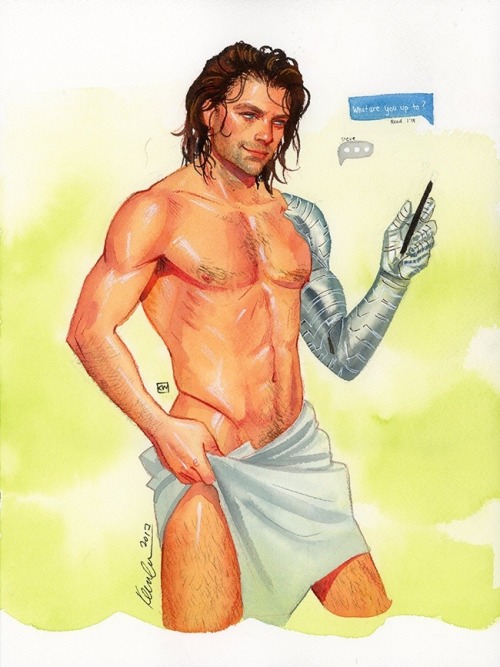
I actually want to draw a comparison using art by Kevin Wada
Kevin Wada is a proud part of the LGBTQ+ community and he has this unique ability to sexualize mainstream male heroes without it looking like a parody. He draws covers for multiple big comic companies and his style reminiscent of old fashion magazines, drawn largely in traditional watercolor, has made him a stalwart of the industry.
He also draws a lot of naked Bucky Barnes.
Anyway, I want to talk about how interesting his art is, the difference between his power poses and his sexy poses for male and female characters.
A typical power pose for a male comics character would look like this
Whereas every so often with female heroes you get something like this
Not all the time, of course, but it happens and it happens in the wrong places. You wouldn’t be posing like a cover model in the middle of a battle, you really wouldn’t.
But when it comes to Wada and male and female characters, the difference is pretty clear.
When he draws male characters, they more often look like this
Sensual, in a pose you wouldn’t usually see a big, muscular hero doing. If not that, then playful, sexy, for looking at, but nothing about their anatomy overly exaggerated
How he draws women is also very clearly different from many other artists, from sexy pose to power pose.
Still posing for the camera, still to be looked at, but very, very different from how we’ve seen female characters portrayed in mainstream comics in the past.
And I guess it’s really just a matter of variety? Objectification in art is a long time debate and appears everywhere always, but for all that we can argue about its impact on popular media, there are a few things I know for sure:
1) having a female character pose like a playboy cover girl in the middle of a battle scene is just Bad Art and y’all need to find better references
2) female power poses will never look quite as right as when they’re drawn by people who know the value of expressing personality through pose (it’s basic animation principles and some artists still need to learn it) and who actually know what a female character’s personality beyond “sexy”
3) Iron Man or Batman posing like they’re about to beat somebody up is 100% not the same as a fashion drawing by Kevin Wada where a Typical Beefy Action Guy gets to pose like a flirty pretty boy
4) the MCU films have figured out the value of pandering to female audiences by sexually objectifying all their male action heroes while simultaneously appealing to the male demographic’s action movie power fantasy. Quoting Chris Hemsworth and Taika Waititi: “I’m not a piece of meat” “Uh, yes you are.”
They definitely struck some kind of balance there.
Also, more important than this entire post: y’all should follow @kevinwada on Tumblr and give him love because his art is divine and his talent beyond words
it’s also because Leonard COHEN (!) was Jewish and this is a quintessentially Jewish line, and changing it to that level of Annoying Certainty is stripping it of its Jewish meaning and imbuing it with that particularly American smug evangelical Christian attitude that makes me tired, so very tired
THAT IS EXACTLY WHY
I don’t think I’ve heard any cover artist sing my favorite verses
You say I took the name in vain
I don’t even know the name
But if I did, well really, what’s it to you?
There’s a blaze of light
In every word
It doesn’t matter which you heard
The holy or the broken Hallelujah
I did my best, it wasn’t much
I couldn’t feel, so I tried to touch
I’ve told the truth, I didn’t come to fool you
And even though
It all went wrong
I’ll stand before the Lord of Song
With nothing on my tongue but Hallelujah
um woah
I will always hit the reblog button so hard for Hallelujah but ESPECIALLY mentions of the elusive final verses which are just about my favorite lyrics ever. Why do people always omit the best part of the song??
In Yiddish
In Hebrew
In Ladino
Yeah, I wonder why the verses that reference specific Jewish mystical and chassidic concepts that aren’t readily understood by American “I love Jews, you know, Jesus was Jewish!” Christians never get any airtime. Funny that.
You say I took the name in vain I don’t even know the name But if I did, well really, what’s it to you? There’s a blaze of light In every word It doesn’t matter which you heard The holy or the broken Hallelujah
These are specifically about Chassidic Jewish theories of the holy language, how each letter and combination of letters in Hebrew contains the essence of the divine spark and if used correctly, can unlock or uncover the divine spark in the mundane material word. And of course, there are secret names of God which, when spoken by any ordinary human would kill them, but if you are worthy and holy and righteous can be used to perform miracles or even to behold the glory of God face-to-face. The words themselves have power. Orthodox Jews often won’t even pronounce the word “hallelujah” in it’s entirety in conversation, because the “yah” sound at the end is a True Name of God (there are hundreds, supposedly) and thus too holy to say outside of prayer.
None of this is to mention how David’s sin in sleeping with Batshevah (the subject of much of the song, with a brief deviation to Shimshon and Delilah) is considered the turning point in the Tanach that ultimately dooms the Davidic line at the cosmological level and thus dooms Jewish sovereignty and independence altogether. From a Christian perspective this led to Jesus, the King of Kings, and that’s all very well and good for them, but for the Jews, the Davidic line never returned and is the central tragedy of the total arc of the Torah. Like, our Bible doesn’t have a happy ending? And that’s what this song is about? There’s no Grace – you just have to sit with the sin and its consequence.
Of course, Cohen is referencing all of this ironically, and personalizing these very high-level religious concepts. Like the point of this song is that Cohen, the songwriter, is identifying with David, the psalmist, and identifying his own sins with David’s. The ache that you hear in this song is that the two thousand year exile that resulted from one wrong night of passion and Cohen feels that the pain he has caused to his lover is of equally monumental infamy. Basically, in a certain light, the whole of Psalms is a vain effort for David to atone for his sin and I think Cohen was writing this song in wonderment that David could eternally praise the God who would not forgive him and would force him and his people into exile. But he ultimately gets how you have to surrender to the inexorable force of God in the face of your own inadequacies and how to surrender is to worship and to worship is to praise – hence, Hallelujah. You can either do the right thing and worship God from the start, or you can fuck up, be punished, and thus be forced to beg for His forgiveness. It’s the terrible inevitability of praise that’s driving him mad.
Like honestly, I identify with this song so strongly as an off-the-derech Jew, I sometimes wonder what Christians can possibly hear in this song, as it speaks so specifically to the sadomasochistic relationship that a lapsed Jew has with their God. It’s such a different song from a Christian theological perspective it’s almost unrecognizable, man. This song continues to be a wonder of postmodern Jewish theology and sexuality from start to finish. Don’t let anyone give you any “Judeo-Christian” narishkeit. This is a Jewish song.
(Sorry about the wild tangent it’s just 2AM and I love this song so dang much, you guys.)
*Minimal headache is still some headache. You’re trying to summarize something that needs thousands of words to properly convey. It’s not going to be easy.
Blurbs are an absolute necessity for marketing your book, and the sooner you have a good one, the easier it is to get people interested in your work. Unless you’re writing a short story, you’ll never be able to include all the interesting parts of your book into a single blurb. That’s okay. The point of the blurb is to pick out the key focus of the story as a whole, and relay that in the most interesting way possible.
When writing blurbs, it’s good to end up with one short/mini blurb, or logline, which should be a single sentence, and one longer blurb which should be a few paragraphs. (Note that a synopsis for a query letter is quite different from a blurb. There are links at the bottom of the post which will help you with a query-worthy synopsis.)
Tips and tricks:
Know what your story is about. No brainer, right? Keep in mind that this isn’t the same as having a summary or outline. You want to know the focus of your story, the thing that remains when you strip everything else away.
Use a formulaic starting point. A good formula to start with looks something like this: “When [INCITING INCIDENT OCCURS], a [SPECIFIC PROTAGONIST] must [OBJECTIVE], or else [STAKES].” Just remember this isn’t a cheat. You’ll still need to rework the resulting sentence.
Start small and expand, or start large and cut out. Figure out a solid short blurb and then turn every key aspect (the protagonist, the inciting event, the objective, and the stakes) into a sentence or two of it’s own, or write the full blurb first and cut away words until you have a single sentence.
Write many versions. Without any rereading, try speed writing 25 short blurbs and 5 long blurbs. Come back when you’re done and pick out the points you feel worked the best and were most true to your story.
Get feedback. Throw your favorite few blurbs at people you trust who are also part of your target audience. Which ones create the most interested in the story itself?
Good explanations on how to write loglines, blurbs, and synopsis, from non-tumblr websites who’s links shouldn’t die:
On short blurbs (loglines)- | One | Two | Three | Four | On long (back of book) blurbs – | One | Two | Three | Four | On query-worthy synopsis- | One | Two | Three |
Edit from 2/23/18:
Since I just spent some time reading a bunch of sci fi and fantasy blurbs in preparation for writing Pearl’s, I thought I might update this.
There is no right way to write a blurb. Some are a single paragraph, some are a full page. Some have quotes from the book, some directly mention the author, some focus just on the plot or dedicate most of their space to the worldbuilding. It doesn’t matter what your blurb looks like as long as it sounds good and gets people interested in your book!
A nice, simple format I’ve found to work really well for Speculative Fiction looks something like this:
Part one
—
The world. Give a strong sense of your worldbuilding and the set up for any political, magical, or technological building blocks important to your plot. This can double as a protagonist (or antagonist!) introduction, or you can leave that for the second paragraph, depending on what flows best.
Part two
—
The inciting event. What happens to get the story rolling? This should be something within your first few chapters, which sets your protagonist on their path. (If it’s not, you may have some structural edits to do for your novel.)
Part three
—
The hook. Leave the reader questioning what’s to come! Focus on the disaster the plot is heading for, or point out a game changer or upcoming obstacle.
As mentioned above, this is certainly not the only way to write blurbs. Some novels downright can’t follow this exact structure for one reason or another. Most don’tneed to. But it’s still a nice, fairly headache-less exercise to try out when working on a blurb, and it might give you something worthwhile once you’re finished.
I get that this is a laugh-at-the-white-guy post, but it’s actually an interesting question.
In the US, the 100 most common surnames represent about 18% of the population. In South Korea, the 5 most common surnames represent more than 50% of the population, with Kim/Gim/Ghim/김 alone being around 22%.
The answer, best as I can find it, is that surnames originally in Korea were much more recently brought to the average person.
In Anglo culture, average people having last names dates back to around the Middle Ages, and your surname could be anything from your profession (Smith, Taylor, Cooper, Chandler, Fisher, etc.) to your geographic location or some feature of it (Barrow, Liscombe, Badgerly, Wyndham, etc.) to some defining feature of you or your ancestor (Red, Brown, Small, Little, Longfellow, etc.). These were reasonably widespread in use and are the origins of most Anglo surnames today.
In Korea, until relatively recently, surnames were only used by the nobility and aristocracy. The ruling family for a long time in some rich and important regions? 김. And so, when everyone started taking on surnames, it was only natural to have your surname (which, remember, was largely geographic in nature, although not named after a geographic location per se) be the same as your ruler. And so you end up with more than half the population sharing the same 5 last names.
A similar thing is at work in China with the surname Wang/Wong/王/汪. The two variations are most common and 58th respectively. The first of these, by the way, 王, means King, just to make the connection a little more obvious. It also represents more than 7% of the population all on its own.
King is a really popular name in general it seems.
Shah and raj both mean king, as does the english name king of course. Im sure theres others in other languages.
I thought that was an interesting hypothesis so I looked into it really quick for the Netherlands, because we didn’t become a monarchy until 1806 (thanks napoleon) so I thought the numbers on royal related last names wouldn’t be that high. The first one in the top 100 comes in at #24, which is de Graaf (the Count), then at #48 we have Prins (Prince) and then at #80, we finally have de Koning (the King). So even here, they’re far more common than I thought.
If you are, then I’ll need you to participate in reblogs so that the lesson takes shape in proper Socratic fashion.
I’M GAME OKAY PLEASE DO.
I mean, im p good at math, I learn quickly and have my dad, brother and some good teachers as my backup for doubts.
But I sure would love someone more experienced bring up a simpler yet effective approach to the table.
Alright then. Let’s begin.
This entire logical progression will begin with a single axiom, or decision. Things can be grouped according to arbitrary decisions. Can you accept that axiom as our beginning?
If you can accept this axiom, that we can group things together according to similarities we indicate, then let us call these groups of things “Sets”.
Can you accept that?
I was really good at that game in high school geometry! I can accept that idea
Excellent!
So now we have the beginning: that things can be grouped together as we like it, and that these groups are called “sets”.
Now, the next step. Can there be nothingness? Can you conceive of it? Can you conceive of an absence of things? (Don’t make this difficult. Go with the simple answer)
I believe so, yes
Very good! Let us call this absence of things “The Empty Set” and let us write that
( )
Does this notation work for you? The parentheses around a set of things?
It does, yes. As long as we do not add more sets of parentheses suddenly
All sets of parentheses denote a set, but we can have nested sets, or sets of sets, As per the next step…to whit…
We have the empty set: ( )
We have nothingness, but something odd has happened. We now not only have the nothingness, but we have the idea of it!
This will get confusing if we don’t write it down. So let us write it:
(( ))
Does this work for you?
Yep! Could we use brackets instead of parentheses on the outside like [( )]?
I’m afraid I have reason to use parentheses. You will see. 🙂
Will (( )) Be alright for now?
Sure
Well, now see here, we now have this other thing that has happened.
We have the Empty Set, and then the idea of it, but then we have the set that contains both of those things. Hmm…
Let us write this: ( (), (()) )
Just for the hell of it.
What say you to this? (Don’t overcomplicate it…it’s not math yet. It’s simply thought)
Seems like sound logic.
Alright, but now…I am having more thoughts.
We have the empty set, the set that contains the idea of the empty set, and the set that contains both the empty set and the set containing the empty set. But what about the set containing the empty set, the set containing the empty set, and the set containing the empty set and the idea of the empty set?
Let’s write that down, before we become too confused, eh?
Let’s write it ( (), (()), ( (), (()) ) )
How do you feel about that? Working for you still?
It’s an entirely rational thing to do, I think.
Ah but…now…there’s this new idea I have.
The set containing the Empty Set, the idea of the empty set, the set containing both the empty set and the idea of the empty set and the set that contains the empty set, the idea of the empty set and the set containing both the empty set and the idea of the empty set.



 blackash26