The answer is sort of, if anyone’s wondering! The first major stumbling block is that you probably can’t legally buy it. The Mona Lisa is priceless in a very real sense, no amount of money will compel the Louvre to part with it on any sort of permanent basis (It has been appraised and given monetary value, but only for insurance purposes) not only for the obvious reasons (who’s going to give up that sort of global recognition?) but also because it’s considered public property under French law, so probably only the government could authorize its sale even if the Louvre’s director and curator wanted to. Also, if they knew you planned to eat it they definitely wouldn’t sell it to you.
Now, assuming you could become its legal owner, you’d still have to leave France. Even if there was a special exception to the rule about sale, French heritage law gives the piece legal protection, much like a historic monument or cultural site. In the U.S., federal law only protects a work from damage until the death of its artist, so you’d be totally cool to eat it. Coincidentally, that’s when any of your art would go up for grabs because you would be dead too! Paint from before plastic was invented is crazy poisonous. Arsenic and cyanide make good pigment apparently!
So, you could be stopped by: The Louvre, the French government, your doctor, any of your loved ones, or anyone who sees what you’re doing and reports an imminent suicide to the police.
St Lucy is the patron saint of anyone with eye problems, primarily because her Latin name Lucia means “light”. Some stories suggest she was martyred by having something nasty done to her eyes, but this seems have been a later invention, since early accounts have her being stabbed in the neck. Anyway, medieval and Renaissance artists liked to identify her in paintings by making her carry around two eyeballs on a plate. Or in a bowl. Or even in a wine glass. Other artists preferred to show the eyeballs growing on a stalk or on a cocktail stick like a really weird canapé, but those serving suggestions are somehow less amusing than tableware.
Meanwhile, the eyes in Lucy’s head can sometimes be seen casting a sideways glance at the receptacle in her hands, probably because it often resembles some sort of bemused Muppet.
I definitely like how some of them are legitimately detached eyeballs, some are disembodied floating eyes complete with shady eyelids, and some give the effect of the artist anthropomorphizing the Object of Proffering by giving it googly eyes. Like, it’s obvious that some artists know that eyeballs are balls, and some people thought that was a figure of speech and obviously eyes have Flesh Curtains on them at all times. Medieval artists are so wild! the way they’re like “ehhhhhh THAT’S GOOD ENOUGH,” it never stops being funny.
It also reminds me of a job interview I had one time where the professor was like “so do you have a problem with eyes” and I was like “I am not… sure…?” and he was like “here take and find out” and I looked at the object in my hand and was like “so this is a… it’s a detached human eyeball, is it?” and he was like “yeah” and I was like “Fresh?” because you have to say SOMETHING, and he was like, “well, Yeah,” and I was like “oh lovely”
but MENTALLY I was like “I … don’t THINK i have a problem with eyes, but I … THINK … that I have a problem with THIS. whatever this is. I mean, it’s fine, but I think i’m,, I think I’m okay not working for you” but it was still an interview so I said “Hmm,” supportively, holding the eyeball (it was cold)
and he held out a dish LIKE SAINT LUCIA, NOW I SEE IT, and I put the eyeball on it and he turned and put it away behind him, anyway I decided I didn’t want that job, but yeah, YEAH, you definitely want to carry an eyeball on a dish, that’s definitely how you want to do that, you don’t want to improvise any more than that.
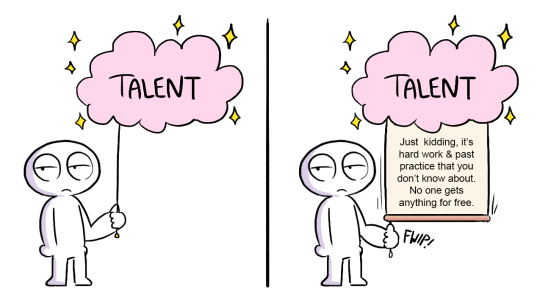
We all start as literal useless babies. No one gets a magic ticket that makes them better at anything. If someone says they “never practice” it’s probably because they like doing the skill and see it as a fun use of their time instead of “practice”.
I will qualify this a small but I think important amount, because what it is is actually complicated:
Some people’s brains and nervous systems are wired for better hand-eye coordination. Some people’s brains and nervous systems are wired for better pattern recognition. Or translations of audio input. Or whatever.
What this does is combine with @jelloapocalypse‘s EXTREMELY WELL-OBSERVED COMMENT (If someone says they “never practice” it’s probably because they like doing the skill and see it as a fun use of their time instead of “practice”.) in a way that can be both invisible and give this kind of person a massive leg up while being really discouraging to someone who doesn’t have that wiring.
It doesn’t get to the actual original comic’s level of “oh I just started here”. But let’s take two people called Riley and Kennedy, and we’ll do singing, since that’s what I teach.
Riley and Kennedy have exactly the same kind of background: parents who listen to the radio sometimes, the usual social stuff around popular music of whatever genre, etc, but no formal training. Neither of them sings in a church choir, neither of them falls into a formal disability category, whatever.
The first time Riley shows up in my studio and we sing a really simple song I use as a diagnostic, she gets it mostly right. She can follow the tune; she can hear pitch, and it takes very little work for her to chivvy her voice into matching that pitch as long as there’s not something pulling her off. (In other words: as long as I’m singing the same notes as her and playing them on the piano, and as long a she can hear both herself and those notes).
For Riley the lesson is really fun and validating and she goes home and sings along to her own music for a while and comes back next week with six songs she wants to try learning. And most of her lessons are like that: pretty easy positive feedback. That means Riley “practices” a lot in exactly the way @jelloapocalypse describes, even if she doesn’t think she’s actually practicing (that is, sitting down to sing the songs we’re working on together in a systematic way) at all.
In contrast, the first time Kennedy comes to my studio, she struggles. It’s harder for her to hear the difference between notes, and it’s much harder for her to make her voice actually match the pitch she wants to sing at. When we pull out the diagnostic tune, she mostly manages to drone a few clusters of semi-tones, and while she can hear that she’s Off, it’s actually very hard for her to tell HOW she’s off, or what she should do to correct it.
In most cases, for Kennedy, lessons – and in fact the overall experience of singing – is not fun. It’s not validating. It’s a whole process of Not Being Good, of Doing Things Wrong, and given the way humans are often in casual situations being laughed at. When Kennedy goes home she doesn’t sing along with any music she plays: she keeps her lips pressed together and at best enjoys other people singing (and maybe feels envious and demeaned because she can’t do it).
Now the thing is, the practical “skill” difference for Riley and Kennedy here at the beginning is minimal. But the Rileys will tend (if they like what they’re doing) to ROCKET UP THE SKILL LEVEL, because of the “practice is fun so it’s just the thing I do” – because there is always a bunch of validation and positive reinforcement in the act of doing whatever it is, be it doodling or singing or math.
The Kennedys won’t. In fact if they’re not lucky enough to have a good teacher, and one who can put a lot of this into perspective for them, they will tend to be inhibited. The worst time is when a Riley and a Kennedy are friends and sign up to learn together, and Riley takes off and Kennedy’s left sitting there feeling like she’s somehow Deeply Flawed.
And in fact the whole Doctrine of “It’s Just About How Hard You Work” will in and of itself become part of what inhibits them, because they will watch the Rileys – and even the Annas, Anna in this metaphor being the Totally Normal Student who never really exists – grasp things faster than they do, even if they ARE working hard. And this will HAPPEN. They will watch this reality happen in front of them … and then people say to them “oh, it’s all about how hard you work, dear.” And it’s like being gaslit. (Well, to be fair: it IS being gaslit, just without malice intended on the part of the people doing it.)
And that message is horribly horribly toxic: here Kennedy is, and she IS working hard, but she’s still not progressing as fast as Riley or Anna no matter what she does! But it’s All About Hard Work, right? So that must mean that no matter how hard she THINKS she’s working, she’s actually just lazy, or doesn’t want it enough. It’s clearly a moral flaw in her.
I actually have, personally, really good luck with teaching the Kennedys because I literally have this conversation with them when they come to my studio. I actually outright tell them: firstly, anyone who has working vocal chords can sing. Anyone who has working vocal chords and the ability to distinguish audio pitch can even sing on key in tune! But some people have an easy time learning this and some people have a hard time, and sometimes which it is has some relationship to, say, “early exposure to music” or whatever but sometimes it seems to be utterly fucking random – pure luck of the draw.
You CAN SING. The capability is there. And if you want to we will find out how to make it happen. It might not happen as fast as for some other person, it might take more work, it might take more care, but that’s okay: that’s not your fault, that doesn’t mean you’re NOT working hard, but it does mean that here at the beginning we do things like recalibrate victories, we make your progress about YOU, not about Riley or Anna.
But I’m also not going to gaslight you or make you feel like you’re either delusional or somehow especially So Terrible You Don’t Fit In The Rest Of The World: sure, I’ve got some Riley-types who walk in here, noodle around, and we go on to Art Songs. They exist.
So what? Tall people exist. People with broad shoulders exist. People with dark hair exist. Physical embodiment and neurology hand out luck of the genetic roulette with no interest in outcomes. If you’re born blonde, it’s always going to take more work for you to have brown hair than someone born with brown hair, but much like dyeing your hair to match what you want, we can train the muscles of your voice and the neural pathways for hearing to do what you want.
The differences between Rileys and Kennedys are very small. If Riley didn’t discover she liked singing and Kennedy worked at it for years then no, Riley would not “start out” as good as Kennedy is after those years. And you can be Riley and if you DON’T do the fucking work, the Annas of the world especially will blast past you and leave you in the dust.
But on the other hand the Rileys get this wonderful cycle of positive reinforcement that does often start from a place of their coincidental physical embodiment giving them a slight leg up. And pretending that’s not the case does a big disservice to the Kennedys.
We just absolutely do need to reframe that for what it is (a tiny fundamental difference and then a HELL OF A LOT OF “this is fun so I practice more so I get more validation so I -” and more or less no moral meaning at all), what it doesn’t mean, and how to compensate for it.
The thing about this is that sculptures like these in art history were for the male gaze. Photoshop a phone to it and suddenly she’s seen as vain and conceited. That’s why I’m 100% for selfie culture because apparently men can gawk at women but when we realize how beautiful we are we’re suddenly full of ourselves…
“You painted a naked woman because you enjoyed looking at her, put a mirror in her hand and you called the painting “Vanity,” thus morally condemning the woman whose nakedness you had depicted for you own pleasure.” ― John Berger, Ways of Seeing
I know I’ve reblogged this before but it’s so important.





 blackash26
